← All topics
SportsCheerleading

Is cheerleading a sport?

Supporters point to flips, throws, injuries and championships. Critics say most squads exist to cheer for someone else.

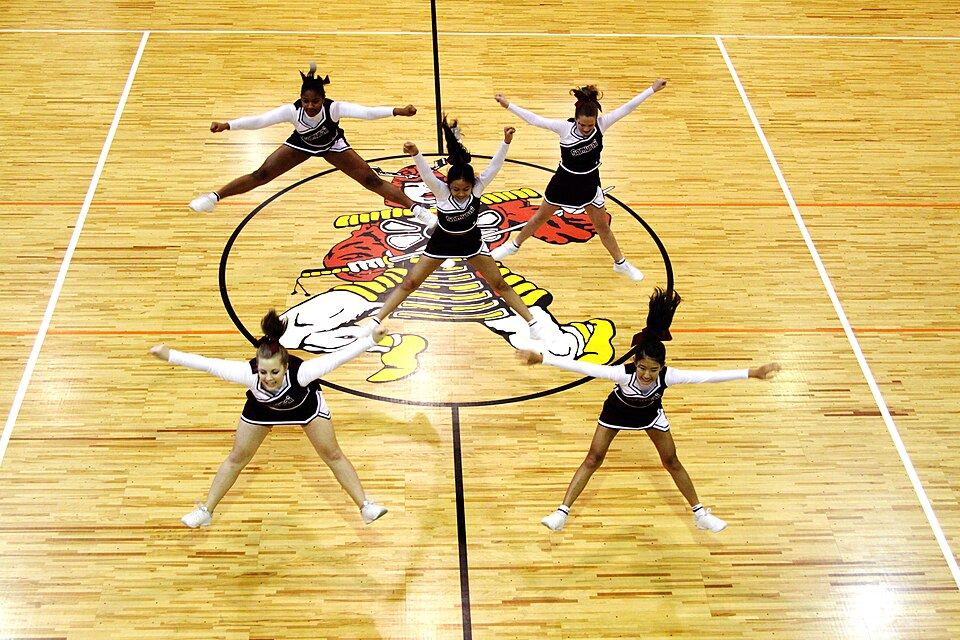
A high school cheer squad doing a jump in formation on a basketball court
Wikimedia Commons · Public domain
Motion: This House believes that competitive cheerleading is a sport5 Pro · 5 Con · 24 sourcesOctober 2026
Article To become a sport, cheer had to stop cheering · read it below ↓

Introduction

Cheerleading now comes in two forms. Traditional, or sideline, cheer leads crowds and supports other school teams at their games. Competitive cheer puts squads on a mat against other squads, where judges score a short routine of stunts, tumbling, jumps and pyramids.20 The debate is whether either form, and especially the second, should count as a sport.

The activity began with men. In 1898 Johnny Campbell, a University of Minnesota student, stood up at a football game and led the crowd in an organized chant. The university did not let women join its cheer squad until 1923.10

Today it is huge, and mostly female. The number of US cheerleaders aged 6 and older grew from about 3 million to 3.6 million between 1990 and 2003.7 In the 2024-25 school year, 206,262 girls and 4,247 boys took part in competitive spirit at US high schools.6 Yet in 2012, only 29 state high school athletic associations recognized cheerleading as a sport.7

The label matters most because of Title IX, the US law that requires schools to give women fair chances to play sports. In 2009, Quinnipiac University in Connecticut planned to cut its women's volleyball team and count a competitive cheer squad instead. Five players and their coach sued. Maryland had already become, in 2003, the first school to use cheer scholarships to meet Title IX.19 In 2010, Judge Stefan Underhill wrote that “Competitive cheer may, some time in the future, qualify as a sport under Title IX,” but that for now it was “still too underdeveloped and disorganized.”1 An appeals court agreed in 2012, concluding that “that time has not yet arrived.”2

Since then, the sports world has moved. The International Olympic Committee gave the International Cheer Union full recognition in July 2021, which allows cheerleading to apply for a place at the Olympics.4 Cheer was added to the 2025 World Games in Chengdu, China.23 In January 2026, NCAA colleges voted to make acrobatics and tumbling a championship sport and to add a stunt championship, with the first acrobatics and tumbling title projected for spring 2027.3

Safety is a big part of the argument. About 26,000 cheerleading injuries happen in the US each year.7 From 1982 to 2008, cheerleading caused 65.2% of catastrophic injuries among female high school athletes and 70.5% among female college athletes.8 “Cheerleading has become extremely competitive in the past few years, incorporating more complex skills than ever before,” said pediatrician Cynthia LaBella in 2012, when the American Academy of Pediatrics urged every state to make it a sport.7

Critics are not convinced. USA Cheer, the national governing body, says traditional cheer “is most appropriately governed as a student activity, not an interscholastic varsity sport.”17 Others worry that a business sits at its center: Varsity Brands, accused of controlling more than 75% of the markets for cheer competitions, camps and uniforms, agreed in 2024 to an $82.5 million antitrust settlement.21
Key terms

Title IX
A 1972 US law that bans sex discrimination in schools and colleges that get federal money, including in sports. Schools must show that women get fair athletic opportunities.
Sideline cheer
Traditional cheerleading that leads crowds and supports other teams at games, rather than competing for its own score.
Competitive cheer
Cheerleading done mainly to compete: squads perform routines that judges score against other squads.
STUNT
A head-to-head version of cheer, played in four quarters, with the crowd-leading removed. It was designed to meet the US government's test for a Title IX sport.
Emerging sport
An NCAA label for a women's sport that colleges are building up. Once enough schools sponsor it at varsity level, it can get its own national championship.
International federation
The world governing body for one sport, which sets its rules and runs world championships. The IOC must recognize it before the sport can apply to join the Olympics.
Catastrophic injury
An injury that kills someone or causes lasting, life-changing harm, such as damage to the skull or spine.
Antitrust
Laws that stop one company from unfairly dominating a market, for example by shutting out rivals and raising prices.

Pros and cons at a glance

Pro: it is a sport

    Con: it is not a sport

      Pro arguments

      Con arguments

      Key clashes

      Most cheerleading debates are won or lost on these four questions.

      1What makes something a sport?

      A question of definition. Both sides can point to a dictionary.

      Pro saysPhysical skill, training and judged competition, the same things that make gymnastics and diving sports. Broad official definitions of sport include it easily.12
      Con saysA sport's main purpose is to compete. Most cheer squads exist to support other teams, which makes them a student activity.17

      2Is competitive cheer organized like a sport?

      Courts have looked at rules, seasons and opponents, not at how hard the flips are.

      Pro saysIt now has a world federation recognized by the IOC and NCAA championships with set rules and seasons.34
      Con saysCourts found its rules and competitions too inconsistent, and it is still split into rival formats.2

      3Would the label help or hurt women in sport?

      Title IX turns the definition into a question about money and opportunities.

      Pro saysMore than 200,000 high school girls cheer competitively and deserve the scholarships, coaches and respect that athletes get.6
      Con saysSchools can relabel a squad they already have and cut a real women's team, as Quinnipiac tried to do.1

      4Does safety depend on being called a sport?

      Both sides want fewer injuries. They disagree on how to get there.

      Pro saysPediatricians say sport status brings qualified coaches, medical care and injury tracking.7
      Con saysCheer's overall injury rate is already low, and safety rules can be set without changing what cheer is for.16

      Around the world

      The US: cheer's status depends on the state and the level. California made competitive cheer an official high school sport in 2017, and the NCAA plans its first acrobatics and tumbling championship for 2027, but US education officials have not certified traditional sideline cheer as a Title IX sport in any state.14317

      Global federation: the International Cheer Union had 116 national federations when the IOC fully recognized it in 2021.5

      Multi-sport games: cheer joined the World Games, a multi-sport event for sports outside the Olympics, starting in 2025 in Chengdu, China.23 A company-backed pro league has said it is aiming for the 2032 Olympics, though no Olympic cheer event has been confirmed.22

      Debate tip: international recognition is strong evidence for Pro. Con can answer that the Olympic question is about elite competitive cheer, while most cheerleaders still cheer from the sidelines.

      Discussion questions

      For class or club discussion. There are no right answers; ask for reasons and evidence.

      1. Is cheerleading a sport? Explain your answer using at least one argument from each side.
      2. Should sideline cheer and competitive cheer be judged separately in this debate? Where exactly is the line between them?
      3. If an activity is judged on how it looks, like gymnastics, diving or cheer, does that make it less of a sport than one decided by goals or times?
      4. Should schools be allowed to count cheer squads toward equal opportunities for women under Title IX? What conditions would you set?
      5. Does it matter who decides what counts as a sport: the Olympics, courts, schools or the athletes themselves?

      Article on this debate

      Sports · By Debatery Editing Team

      To become a sport, cheer had to stop cheering

      Acrobatics and tumbling and STUNT grew out of cheerleading and will hold their first NCAA championships in 2027. Their rise raises a question about the cheerleaders still on the sideline.

      Read the article

      Sources

      1. David Moltz, “Key Title IX Ruling,” Inside Higher Ed, July 21, 2010. LinkNews report
      2. Mark Walsh, “Appeals Court: Cheerleading Not a Sport for Title IX Purposes,” Education Week, August 7, 2012. LinkNews report on court ruling
      3. NCAA, “NCAA elevates acrobatics and tumbling to championship status,” January 16, 2026. LinkSports governing body
      4. Filip Vachuda, “IOC gives full recognition to six new International Federations,” Around the Rings, July 21, 2021. LinkNews report
      5. USA Cheer, “USA Cheer welcomes International Olympic Committee's full recognition of the International Cheer Union,” July 20, 2021. LinkGoverning body statement
      6. National Federation of State High School Associations (NFHS), “2024-25 High School Athletics Participation Survey,” 2025. LinkNational survey
      7. American Academy of Pediatrics, “New guidelines to prevent cheerleading injuries,” via ScienceDaily, October 22, 2012. LinkMedical association
      8. University of North Carolina, “Catastrophic sports injury report released,” on the National Center for Catastrophic Sport Injury Research's 26th annual report, June 25, 2009. LinkUniversity research center
      9. Kathleen Kingsbury, “Cheerleading's Risky Lack of Rules,” TIME, August 18, 2008. LinkNews report
      10. Jonny Walfisz, “Culture Re-View: How a male student in 1898 created cheerleading,” Euronews, November 2, 2023. LinkNews feature
      11. US Department of Education, Office for Civil Rights, “Dear Colleague Letter: Athletic Activities Counted for Title IX Compliance,” September 17, 2008. LinkGovernment guidance
      12. Council of Europe, Committee of Ministers, Recommendation No. R (92) 13 rev on the Revised European Sports Charter, revised May 16, 2001. LinkInternational body
      13. California State Senate, committee analysis of Assembly Bill 949 (competition cheer), June 30, 2015. LinkLegislative analysis
      14. Lee Green, “Impact of Competitive Cheer Laws, Regulations on Title IX Compliance,” NFHS, April 16, 2019. LinkLegal analysis
      15. Bryan Toporek, “Concussions Found to Be the Most Common H.S. Cheerleading Injury,” Education Week, December 10, 2015. LinkNews report on study
      16. Dustin W. Currie and colleagues, study of high school cheerleading injuries, Pediatrics, 2015 (doi 10.1542/peds.2015-2447), as summarized by 2 Minute Medicine. LinkPeer-reviewed study
      17. USA Cheer, “Position Paper on Cheer Safety & Title IX,” February 28, 2020. LinkGoverning body position
      18. Frank Deford, “Women's Sports, Title IX And The Cheerleader Option,” NPR Morning Edition, November 25, 2009. LinkRadio commentary
      19. Associated Press, “Cheerleading now a U of Md. sport,” NBC News, 2003. LinkNews report
      20. “Cheerleading's peculiar path to potential Olympic sport,” The Conversation, by a historian of women's sport. LinkAcademic commentary
      21. Office of the Illinois Attorney General, “Attorney General Raoul announces $82.5 million proposed settlement with Varsity Brands,” August 26, 2024. LinkGovernment statement
      22. Maxwell Millington, “New Pro Cheer League propels Olympic dreams,” Axios, June 24, 2025. LinkNews report
      23. “Gimme an I-W-G-A! Cheer Added as Podium Sport to World Games,” Sports Destination Management, May 2024. LinkTrade news
      24. US District Court for the District of Connecticut, Biediger v. Quinnipiac University, No. 3:09-cv-00621, ruling on motion to lift the injunction, March 4, 2013. LinkCourt ruling

      Arguments marked “Evidence needed” are waiting for a source before this guide goes live.

      You might also debate

      Practise this topic

      Suggest an argument or source

      Anyone can suggest improvements. An editor checks every suggestion and source before it's added, and you're credited by name.

      Mockup: suggestions aren't saved yet.