1Is voting a right or a duty?
A question of principle about what citizens owe their country.
Supporters say democracy works best when everyone takes part. Opponents say a free country should not punish people for staying home.
Compulsory voting means the law requires eligible citizens to take part in elections, with a penalty, usually a small fine, for anyone who stays away without a good reason. In practice, most systems only require people to show up or return a ballot. Nobody checks how they mark it, and in Australia a blank ballot simply counts as an informal vote.1
The idea is more than a century old. Belgium made voting compulsory in the years after it widened the right to vote in 1893, and Australia followed for federal elections in 1924, hoping to raise turnout and cut what parties spent on campaigns.23 It worked quickly: turnout jumped from 59.38% in 1922 to 91.38% at the 1925 election.4
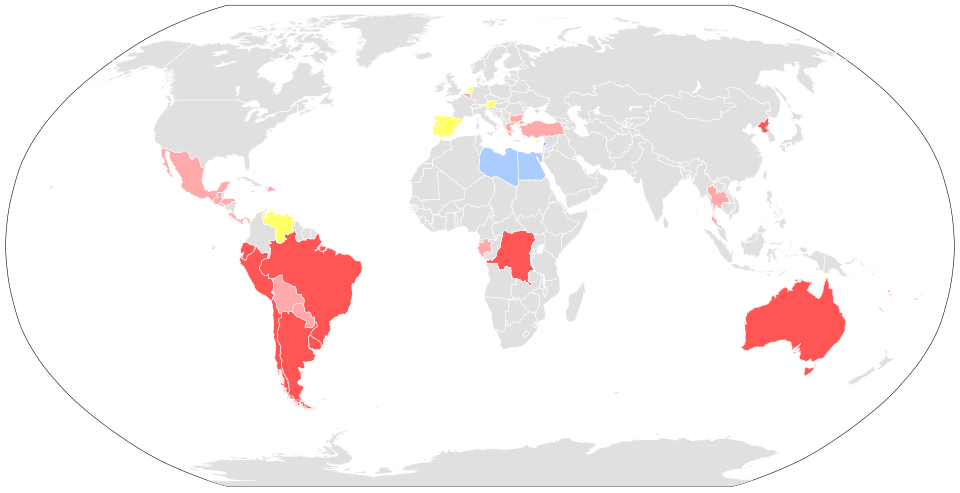
Today the picture is mixed. International IDEA lists about 40 countries with compulsory voting laws, from Argentina and Brazil to Belgium and Singapore, but in roughly half of them the law is not enforced, and IDEA admits that any exact count is “quite arbitrary.”5 Australia enforces its law firmly: 90.7% of enrolled voters turned out in 2025, and about 1.3 million people were sent notices asking why they had not voted.67 Brazil's fine is tiny, at R$3.51, but an unpaid fine can block a passport or a government salary.8
The United States has no such law. In the 2024 presidential election, 65.3% of US citizens voted. Turnout reached 74.7% among people 65 and older, while less than half of 18-to-24-year-olds voted.9 In 2020 a Brookings Institution and Harvard working group called for universal voting in the US, warning that “Low turnout is aggravated by the hyper-polarization in our political life.”10
Some places have recently changed course. Chile made voting compulsory in 2022, after several elections with very low turnout. In the first round of its 2025 presidential election, turnout hit 84.4%, compared with 47.6% in 2021.11 Flanders, in northern Belgium, went the other way. Its October 2024 local elections were the first without compulsory attendance, and turnout fell to 63.5%.12 In Washington state, a 2023 bill would have required every eligible resident to return a ballot, with no penalty. One state senator called it “an unconstitutional, un-American distraction.”13
The debate turns on a few big questions. Political scientist Arend Lijphart argued that low turnout is also unequal turnout, because less well-off citizens vote less, and that the advantages of compulsory voting “far outweigh” the objections.14 Philosopher Jason Brennan argues in a 2014 book that compulsory voting is “unjust and a petty violation of citizens' liberty.”15 Critics also ask whether forced voters will be informed ones, whether penalties are fair to the poor, and whether gentler reforms, like automatic registration, could raise turnout without punishing anyone.14 Others warn that compulsion can hide distrust instead of curing it: even in Australia, only 25% of people said in 2019 that people in government can be trusted.16
Most compulsory voting debates are won or lost on these four questions.
A question of principle about what citizens owe their country.
Both sides agree turnout rises. They disagree about what that achieves.
A question about what a government's mandate really rests on.
Even a small fine raises hard questions about enforcement.
Australia: voting has been compulsory in federal elections since 1924, and turnout was 90.7% in 2025.36
Latin America: Argentina, Brazil, Chile, Peru and Uruguay all enforce compulsory voting.5
Europe: Belgium and Luxembourg still require voting.5 The Netherlands abolished compulsory voting in 1970, and Flanders dropped it for local elections in 2024, after which turnout fell to 63.5%.2712
The US: there is no national requirement. A 2023 Washington state bill would have required residents to return a ballot, with no penalty.13
Debate tip: comparing countries is useful evidence on both sides. Pro can point to Australia and Chile; Con can point to the Netherlands and Flanders, and argue that each country should decide by its own values.
For class or club discussion. There are no right answers; ask for reasons and evidence.
Arguments marked “Evidence needed” are waiting for a source before this guide goes live.
Anyone can suggest improvements. An editor checks every suggestion and source before it's added, and you're credited by name.