← All topics
Society and CultureBeginner to AdvancedWSDCBPPublic Forum

Should schools and workplaces have dress codes?

Supporters say clear rules keep people safe, focused and professional. Critics say they police girls, Black students and religious minorities.

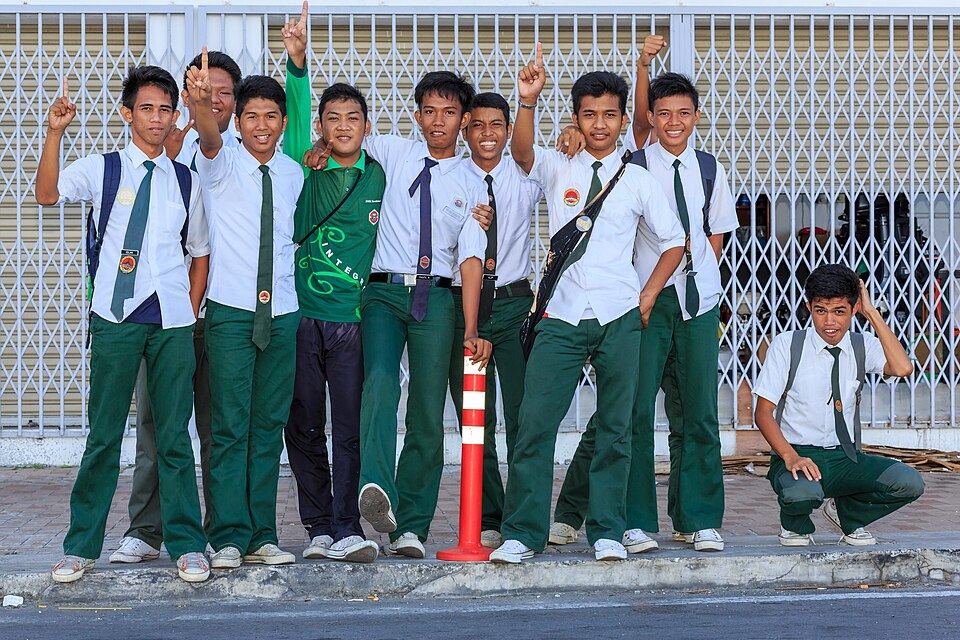
Schoolboys in white shirts and dark trousers walking together
CEphoto, Uwe Aranas · CC BY-SA 3.0
Motion: This House would require dress codes in schools and workplaces5 Pro · 5 Con · 28 sourcesOctober 2026

Introduction

A dress code is a set of rules about what people may wear, and sometimes how they wear their hair, at school or at work. It is not the same as a uniform, which tells everyone to wear the same outfit. A dress code usually lists what is not allowed, such as short skirts, hats or clothes with offensive slogans, or sets a general standard such as “business attire.”

The modern school debate goes back to 1969, when the US Supreme Court ruled in Tinker v. Des Moines that students do not “shed their constitutional rights to freedom of speech or expression at the schoolhouse gate.”3 In 1996 President Bill Clinton pushed the other way, warning that clothes “bearing special colors or insignias” were being used “to identify gang membership.”4

Dress codes are now a normal part of American school life. In 2019–20, 43.7% of US public schools said they enforced a strict dress code and 18.8% required uniforms.1 A 2022 review by the Government Accountability Office (GAO), a federal watchdog, found that districts restrict clothes typically worn by girls, such as skirts, tank tops and leggings, more often than clothes typically worn by boys. More than four in five mostly Black schools enforced strict dress codes, compared with about one third of mostly white schools.2

Courts keep being asked where the limits are. In 2022 a federal appeals court ruled 10 to 6 that Charter Day School in Leland, North Carolina, could not force girls to wear skirts. The school's founder had described a woman as “a fragile vessel that men are supposed to take care of and honor.”5 In Texas, Barbers Hill High School kept Darryl George out of regular classes for most of his junior year because his locs broke a hair-length rule for boys.1213

Workplaces have their own disputes. In London in December 2015, receptionist Nicola Thorp was sent home without pay for wearing flat shoes instead of heels 2 to 4 inches high. Her petition calling such rules “outdated and sexist” gathered more than 150,000 signatures.6 In the United States, the Supreme Court ruled in 2015 for Samantha Elauf, a Muslim teenager who was turned down for a job at Abercrombie & Fitch because her headscarf clashed with the company's dress rules.10

Meanwhile, many employers are relaxing. In 2019 the Wall Street bank Goldman Sachs moved its more than 36,000 staff to a “flexible” dress code, pointing to “the changing nature of workplaces generally in favor of a more casual environment.”7 Even so, it told staff meeting clients to dress the way those clients expect.

The debate has three main fault lines. Supporters say clear rules keep people safe, help them focus and show respect for customers, patients and classmates. Opponents say dress codes fall hardest on girls, Black students and religious minorities, and punish people for how they look rather than what they do. Between them sits a practical question: if a dress code exists, what would a fair one look like?
Key terms

Grooming policy
The part of a dress code that covers hair, beards, make-up and jewellery rather than clothes. Many hair disputes are about grooming policies.
Disparate impact
When a rule that looks neutral on paper falls much more heavily on one group, such as girls or Black students, in practice.
Sex stereotyping
Treating people according to fixed ideas about how men and women should look or behave, such as requiring only women to wear heels or skirts.
Religious accommodation
An exception to a rule so that someone can follow their faith, such as wearing a headscarf, turban or beard at work.
Undue hardship
The legal test for when an employer may refuse a religious accommodation in the US: the burden must be substantial for the business.
Exclusionary discipline
Punishment that removes a student from class or school, such as being sent home, in-school suspension or suspension.
Enclothed cognition
The idea, tested by psychologists, that the clothes you wear can change how you think and perform, not only how others see you.
Secularism (laïcité)
The principle that the state and its institutions stay neutral on religion. In France it is the basis for banning religious symbols in public schools.

Pros and cons at a glance

Pro: have dress codes

    Con: drop dress codes

      Pro arguments

      Con arguments

      Key clashes

      Most dress code debates are won or lost on these four questions.

      1Who decides what is “appropriate”?

      Every dress code rests on a judgment about what looks right.

      Pro saysSchools and employers are responsible for safety, learning and their public image, so they have to set some standard. Courts accept that schools can teach “the habits and manners of civility.”20
      Con says“Appropriate” usually means what people in charge are used to. Students do not shed their right to expression “at the schoolhouse gate.”3

      2Neutral rules or hidden bias?

      Both sides agree rules should be fair. They disagree about whether they are.

      Pro saysA written rule that applies to everyone is fairer than leaving each teacher or manager to judge clothes on the spot.
      Con saysFederal data show strict codes are far more common in mostly Black schools, and rules on skirts and leggings mostly affect girls.2

      3Does clothing really change behavior?

      The research is real but mostly small and done in labs.

      Pro saysExperiments show clothes affect attention, confidence and how much patients trust a doctor.1617
      Con saysBanning leggings or locs has nothing to do with lab coats, and schools with strict dress codes remove more students from class.2

      4Reform the rules or scrap them?

      This is where many real schools and companies have ended up.

      Pro saysCodes can be rewritten to be gender-neutral and kept short, as Portland and Evanston did, without giving up rules altogether.2728
      Con saysEvery rule needs enforcing, and enforcement is where bias creeps in. The fewer rules, the fewer students and workers punished for how they look.21

      Around the world

      France: public schools have banned religious symbols such as headscarves, kippas and crosses since 2004. In 2023 the government added the abaya, a long robe; on the first day of school 67 girls who refused to change were sent home, and the country's top administrative court upheld the ban.89

      India: a dispute that began when a college in Udupi, Karnataka, was accused of barring six girls who wore hijabs reached the Supreme Court, whose two judges split in October 2022. One called wearing a hijab “a matter of choice, nothing more nothing less.”25

      The UK: after the Nicola Thorp case, the government said in 2018 that requiring women to wear high heels is likely to be unlawful, while confirming that dress codes themselves are legitimate.19

      Japan: in 2019 the #KuToo campaign handed the labour ministry a petition against high-heel rules signed by nearly 20,000 people.24

      The US: Texas is one of 24 states with a CROWN Act banning discrimination over natural hairstyles, as of 2023.12

      Debate tip: comparing countries cuts both ways. Con can show how dress rules have been used against religious minorities; Pro can argue that every society sets some standard, and the real question is who it protects.

      Discussion questions

      For class or club discussion. There are no right answers; ask for reasons and evidence.

      1. Should schools and workplaces have dress codes? Explain your answer using at least one argument from each side.
      2. Is a rule about safety, such as tying back long hair near machines, different in kind from a rule about looking “professional”? Where is the line?
      3. If a rule applies to everyone but mostly affects one group, is it still a fair rule?
      4. Should students have a say in writing their school's dress code? What would you put in it, and what would you leave out?
      5. Is it reasonable for a business to set dress rules to match what customers expect, even if workers disagree?

      Sources

      1. National Center for Education Statistics, Digest of Education Statistics, Table 233.50, “Percentage of public schools with various safety and security measures: Selected years, 1999-2000 through 2019-20,” 2022. LinkGovernment statistics
      2. US Government Accountability Office, “K-12 Education: Department of Education Should Provide Information on Equity and Safety in School Dress Codes,” GAO-23-105348, October 25, 2022. LinkGovernment report
      3. United States Courts, “Facts and Case Summary: Tinker v. Des Moines,” on Tinker v. Des Moines Independent Community School District, 393 U.S. 503 (1969). LinkCourt ruling summary
      4. President Bill Clinton, “Memorandum on the Manual on School Uniforms,” February 24, 1996, The American Presidency Project. LinkPresidential document
      5. “NC charter school can't require girls to wear skirts, court rules,” WUNC, June 15, 2022. LinkNews report
      6. Associated Press, “UK lawmakers to companies: End sexist high-heel dress codes,” KTVU, March 6, 2017. LinkNews report
      7. “Goldman Sachs relaxes its dress code,” CNN Business, March 5, 2019. LinkNews report
      8. “Schools in France send dozens of Muslim girls home for wearing abayas,” Al Jazeera, September 5, 2023. LinkNews report
      9. “France's top court rejects appeal against ban on wearing abaya in schools,” Al Jazeera, September 8, 2023. LinkNews report
      10. “Supreme Court rules for Muslim denied Abercrombie job over hijab,” The Christian Science Monitor, June 1, 2015. LinkNews report
      11. Supreme Court of the United States, EEOC v. Abercrombie & Fitch Stores, Inc., 575 U.S. 768 (2015), Legal Information Institute. LinkCourt ruling
      12. “A Black Texas student sues after he was suspended over his hairstyle,” NPR, September 22, 2023. LinkNews report
      13. Pooja Salhotra and Alejandro Serrano, The Texas Tribune, “A Texas school has punished a Black student over his hairstyle for months. Neither side is backing down,” via KSAT, February 22, 2024. LinkNews report
      14. NHS England / Department of Health, “Guidance on uniform and workwear policies for NHS employers,” 2010, via the National Resource for Infection Control. LinkGovernment guidance
      15. Occupational Safety and Health Administration, “Woodworking eTool: Machine Hazards, Rotary and Reciprocating Movements.” LinkGovernment guidance
      16. University of Michigan Institute for Healthcare Policy and Innovation, “What doctors wear really does matter, study finds,” on Petrilli et al., BMJ Open, June 2018. LinkPeer-reviewed study, via university
      17. Christian Jarrett, “Introducing enclothed cognition: how what we wear affects how we think,” British Psychological Society, March 1, 2012, on Adam and Galinsky, Journal of Experimental Social Psychology, 2012. LinkPeer-reviewed study, via professional body
      18. “Power Suits: How Dressing For Success At Work Can Pay Off,” NPR, March 2016, on research by Michael Kraus of the Yale School of Management. LinkNews report
      19. Government Equalities Office (UK), “Dress codes and sex discrimination: what you need to know,” May 17, 2018. LinkGovernment guidance
      20. Supreme Court of the United States, Bethel School District No. 403 v. Fraser, 478 U.S. 675 (1986), via Open Casebook. LinkCourt ruling
      21. National Women's Law Center, “Dress Codes Hurt Learning for Black Girls in D.C., New NWLC Report Finds,” on Dress Coded: Black Girls, Bodies, and Bias in D.C. Schools, April 24, 2018. LinkAdvocacy group report
      22. The CROWN Coalition, “CROWN Act Research Studies,” including the 2019 Dove CROWN Research Study. LinkAdvocacy coalition research
      23. “N.J. ref suspended for 2 years over forced haircut of wrestler with dreadlocks,” WHYY, September 18, 2019. LinkNews report
      24. “#KuToo drive a hit but Japan minister says high heels ‘necessary’,” Al Jazeera, June 6, 2019. LinkNews report
      25. “India: Hijab ban case in Karnataka reaches split verdict; matter to be placed before CJI,” Khaleej Times, October 13, 2022. LinkNews report
      26. US Equal Employment Opportunity Commission, “Religious Garb and Grooming in the Workplace: Rights and Responsibilities,” March 6, 2014. LinkGovernment guidance
      27. “ETHS opts for new, more progressive dress code,” The Daily Northwestern, September 17, 2017. LinkStudent newspaper
      28. “Oregon's model dress code aims to make school policies more fair,” Oregon Public Broadcasting, September 21, 2018. LinkPublic broadcaster

      Arguments marked “Evidence needed” are waiting for a source before this guide goes live.

      You might also debate

      Practise this topic

      Suggest an argument or source

      Anyone can suggest improvements. An editor checks every suggestion and source before it's added, and you're credited by name.

      Mockup: suggestions aren't saved yet.