← All topics
Health and MedicineBeginner to AdvancedWSDCBPPublic Forum

Should organ donation be opt-out?

Supporters say most people already want to donate and the law should assume it. Opponents say a gift only counts if someone actually chose to give it.

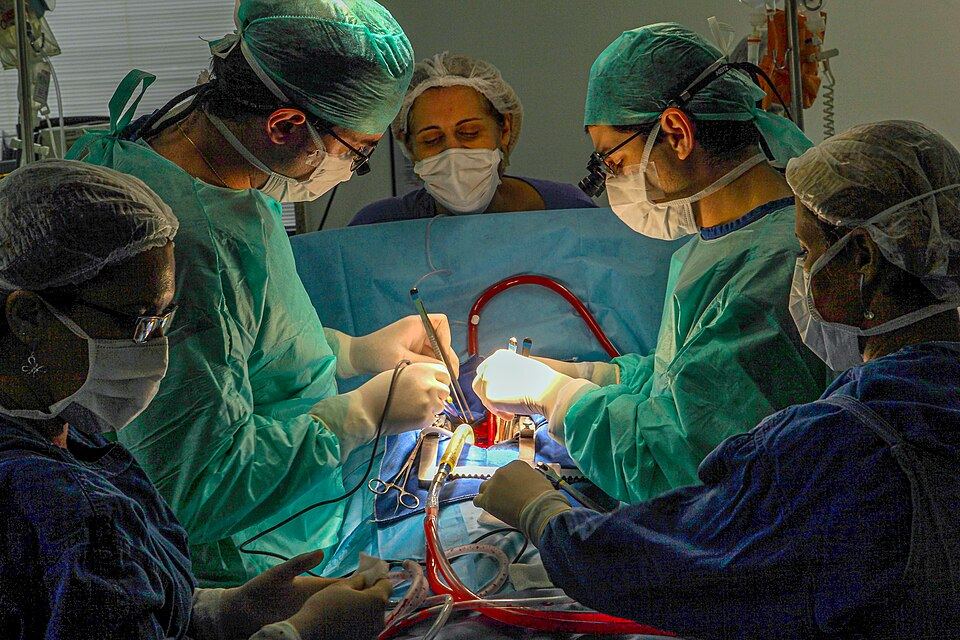
Surgeons at work during a heart transplant operation
Hansfotos · CC BY-SA 4.0
Motion: This House would make organ donation opt-out5 Pro · 5 Con · 26 sourcesEditor review: pending

Introduction

Organ donation means giving a kidney, liver, heart, lungs or other organs to someone who needs a transplant. Most donated organs come from people who have died. This debate is about consent: what the law should assume when a person never said whether they wanted to donate. In an opt-in system, like the one in the United States, people become donors only if they sign up. In an opt-out system, every adult is treated as a willing donor unless they have registered a refusal.

The need is large. As of July 2026, 109,817 people were on the US national transplant waiting list, another person was added every 7 minutes, and 12 people died each day while waiting.1 Yet in a 2025 federal survey, 93% of American adults said they supported organ donation, while only 53% had actually signed up as donors.2 Supporters of opt-out say that gap costs lives.

Spain is the example both sides argue over. Its law has presumed consent since 1979.4 In 2024 it reached 52.6 deceased donors per million people, a rate the Spanish government described as “never before seen in any country in the world.”3 Yet Spain's transplant chief and two British doctors wrote in 2010 that Spain's success “cannot reasonably be attributed to its presumed consent laws,” because families are always asked and the real change was a national network of hospital transplant coordinators.4

The United Kingdom offers newer evidence. Wales became the first UK nation to switch, in December 2015, followed by England in 2020 and Scotland in 2021.151324 A study of Wales found that families became more likely to agree to donation, but only after about three years.5 In England, though, consent rates fell from 67% in 2019 to 61% in 2023, a drop researchers say is hard to separate from the COVID-19 pandemic.6

Other countries show the risks. Brazil made every adult a presumed donor in 1998, but people rushed to register refusals; in the city of Porto Alegre, 83% of residents did. The government abolished the law within a year.11 After Chile switched in 2010, more than 2.7 million people had opted out by July 2012, and the number of deceased donors fell rather than rose in the first two years.12

No US state has adopted opt-out. When Nevada debated becoming the first in 2021, state senator Keith Pickard warned, “The general consensus has been that the government can't make choices over our bodies, over our personal autonomy.”16 Americans are split too: in 2025, 53% said they would support a national presumed consent system, and 37% said they would opt out of one.2

The debate comes down to three questions. Does silence really mean yes? Does changing the law actually change what families decide at the bedside? And could it damage the public trust that every donation system depends on?
Key terms

Presumed consent
The legal rule behind opt-out systems: a person who has not refused is treated as agreeing to donate. The UK calls it “deemed consent.”
Opt-in system
A system where people become donors only if they actively register or their family agrees, as in the United States.
Soft opt-out
An opt-out system where doctors still talk to the family, who can block a donation, as in Wales, England, Scotland and Spain in practice.
Hard opt-out
A strict opt-out system where organs can be taken from anyone who did not refuse, without the family's agreement.
Mandated choice
A system where adults must record a yes or no, for example when getting a driving licence, so nobody's wishes are left unknown.
Default effect
The finding from behavioral science that people tend to stick with whatever option is already chosen for them.
Organ procurement organization
In the US, a nonprofit that works with hospitals and families to recover donated organs and send them to patients.
Family veto
When relatives refuse donation even though the person who died had agreed or was presumed to agree.

Pros and cons at a glance

Pro: make it opt-out

    Con: keep it opt-in

      Pro arguments

      Con arguments

      Key clashes

      Most opt-out debates are won or lost on these four questions.

      1Does silence mean yes?

      A question of principle about what consent means.

      Pro saysMost people want to donate but never sign up. A default that matches their wishes, with an easy way to say no, respects them more than one that ignores them.2
      Con saysA gift has to be given. Treating silence as agreement is only fair if everyone knows about the rule, and many people do not.17

      2Does the law itself raise donation?

      Both sides use the same country comparisons and read them differently.

      Pro saysStudies across dozens of countries find more deceased donors and more kidney and liver transplants where consent is presumed.89
      Con saysSpain's transplant leaders credit their hospitals, not the law, and consent rates in the UK fell after the switch.46

      3Will it build trust or damage it?

      Every donation system depends on the public believing doctors act in patients' interests.

      Pro saysIn Wales, families grew more willing to agree as the new law became normal.5
      Con saysIn Brazil the public saw the law as a threat and it collapsed within a year.11

      4Who should decide: the person or the family?

      Even opt-out countries usually still ask relatives.

      Pro saysFamilies find it far easier to say yes when they know what their relative wanted, and a clear legal default helps.25
      Con saysReligious communities and grieving families should not have to fight a legal presumption at the bedside.21

      Around the world

      Europe: Spain has presumed consent in law but always asks families.4 Austria's opt-out system puts 99.98% of people in the donor pool, compared with 12% in opt-in Germany.10 The Netherlands passed an opt-out law by the narrowest margins in 2018, while Germany's parliament rejected one in 2020.2320

      The UK: Wales (2015), England (2020) and Scotland (2021) all moved to soft opt-out systems.151324

      Latin America: Brazil abandoned opt-out in 1998 after less than a year, and Chile switched in 2010 but saw millions opt out.1112

      The US: Every state uses opt-in. Nevada debated a switch in 2021.16

      Debate tip: country comparisons are useful on both sides. Pro can point to the higher donor rates in many opt-out countries; Con can argue that hospitals, funding and public trust explain those numbers better than the law does.

      Discussion questions

      For class or club discussion. There are no right answers; ask for reasons and evidence.

      1. Should organ donation be opt-out? Explain your answer using at least one argument from each side.
      2. Is not saying no the same as saying yes? Can you think of other areas of life where silence is treated as agreement?
      3. If families can still refuse in a soft opt-out system, what does the law really change?
      4. Should a person's family be allowed to overrule what that person wanted, in either direction?
      5. Would mandated choice, where everyone must record a yes or no, be a fairer middle path? Why or why not?

      Sources

      1. Health Resources and Services Administration, “Organ Donation Statistics,” organdonor.gov, accessed October 2026. LinkGovernment data
      2. Health Resources and Services Administration, “2025 National Survey of Organ Donation Attitudes and Practices: Final Report,” 2025. LinkGovernment survey
      3. Government of Spain, La Moncloa, “Spain, with over 6,400 transplants, exceeds forecasts for 2024,” January 16, 2025. LinkGovernment report
      4. John Fabre, Paul Murphy and Rafael Matesanz, “Presumed consent is unnecessary,” BMJ 2010;341:c4973, October 30, 2010 (copy submitted to the Northern Ireland Assembly). LinkPeer-reviewed analysis
      5. S. Madden and others, “The effect on consent rates for deceased organ donation in Wales after the introduction of an opt-out system,” Anaesthesia 75(9), 2020. LinkPeer-reviewed research
      6. Leah McLaughlin, “Opt-out laws designed to make organ donation easier may have actually made it harder,” Bangor University (from The Conversation), October 8, 2024. LinkUniversity research
      7. Leah McLaughlin and Nicholas Mays, “What Does the Evaluation of the Organ Donation (Deemed Consent) Act 2019 in England Tell Us About the Effectiveness of Deemed Consent Systems for Deceased Organ Donation?” Transplantation, 2024. LinkPeer-reviewed research
      8. Lee Shepherd, Ronan E. O'Carroll and Eamonn Ferguson, “An international comparison of deceased and living organ donation/transplant rates in opt-in and opt-out systems: a panel study,” BMC Medicine 12:131, September 24, 2014. LinkPeer-reviewed research
      9. Alberto Abadie and Sebastien Gay, “The Impact of Presumed Consent Legislation on Cadaveric Organ Donation: A Cross Country Study,” National Bureau of Economic Research Working Paper 10604, July 2004. LinkEconomic research
      10. Columbia Business School, “Opt-Out Best Plan for Donors,” on research by Eric J. Johnson and Daniel G. Goldstein, July 30, 2013. LinkUniversity research
      11. Troy R. Jenson, “Organ Procurement: Various Legal Systems and Their Effectiveness,” Houston Journal of International Law 22(3), 2000. LinkLaw journal
      12. Alejandra Zúñiga-Fajuri, “Increasing organ donation by presumed consent and allocation priority: Chile,” Bulletin of the World Health Organization 93:199–202, 2015. LinkInternational health journal
      13. NHS Blood and Transplant, “Timeline for Max and Keira's Law.” LinkPublic health service
      14. NHS Blood and Transplant, “Landmark day for organ donation law in Wales: soft opt-out system comes into force,” December 1, 2015. LinkPublic health service
      15. Welsh Government, Carwyn Jones, “Written Statement: Introduction of deemed consent for organ donation in Wales,” December 1, 2015. LinkGovernment statement
      16. April Corbin Girnus, “Organ donor bill prompts Republican to warn gov't will ‘make choices over our bodies’,” Nevada Current, March 10, 2021. LinkNews report
      17. American Medical Association, Code of Medical Ethics Opinion 6.1.4, “Presumed Consent & Mandated Choice for Organs from Deceased Donors.” LinkProfessional body
      18. Rob Stein, “‘Horrifying’ mistake to take organs from a living person was averted, witnesses say,” NPR, October 17, 2024. LinkNews report
      19. Jen Christensen, “HHS says it will begin reforms of organ donation system after federal investigation finds ‘horrifying’ problems,” CNN (via KVIA), July 21, 2025. LinkNews report
      20. Associated Press, “German parliament votes against new system for organ donors,” January 16, 2020 (via KSL). LinkNews report
      21. Jack Mendel, “Proposed opt-out organ donation scheme is ‘a threat to Jewish freedoms’,” Jewish News, February 21, 2018, reporting the Board of Deputies of British Jews. LinkNews report, community group's position
      22. US Department of Health and Human Services, Office of Minority Health, “Organ Donation and African Americans.” LinkGovernment data
      23. Christopher Anderson, “Netherlands senate approves automatic organ donor registration,” JURIST, February 14, 2018. LinkLegal news
      24. Scottish Government, “Organ and tissue donation opt out system,” September 14, 2020. LinkGovernment announcement
      25. Kidney Care UK, “NHS launches Leave Them Certain campaign,” December 30, 2020, reporting NHS Blood and Transplant figures. LinkNHS figures, via charity
      26. Mary Steffel, Elanor F. Williams and David Tannenbaum, “Does changing defaults save lives? Effects of presumed consent organ donation policies,” Behavioral Science & Policy 5(1), 2019. LinkPeer-reviewed review

      Arguments marked “Evidence needed” are waiting for a source before this guide goes live.

      You might also debate

      Practise this topic

      Suggest an argument or source

      Anyone can suggest improvements. An editor checks every suggestion and source before it's added, and you're credited by name.

      Mockup: suggestions aren't saved yet.