← All topics
Crime and JusticeBeginner to AdvancedWSDCBPPublic Forum

Should guns be more tightly controlled?

Supporters say stricter laws would save thousands of lives. Opponents say they would disarm law-abiding people while criminals ignore them.
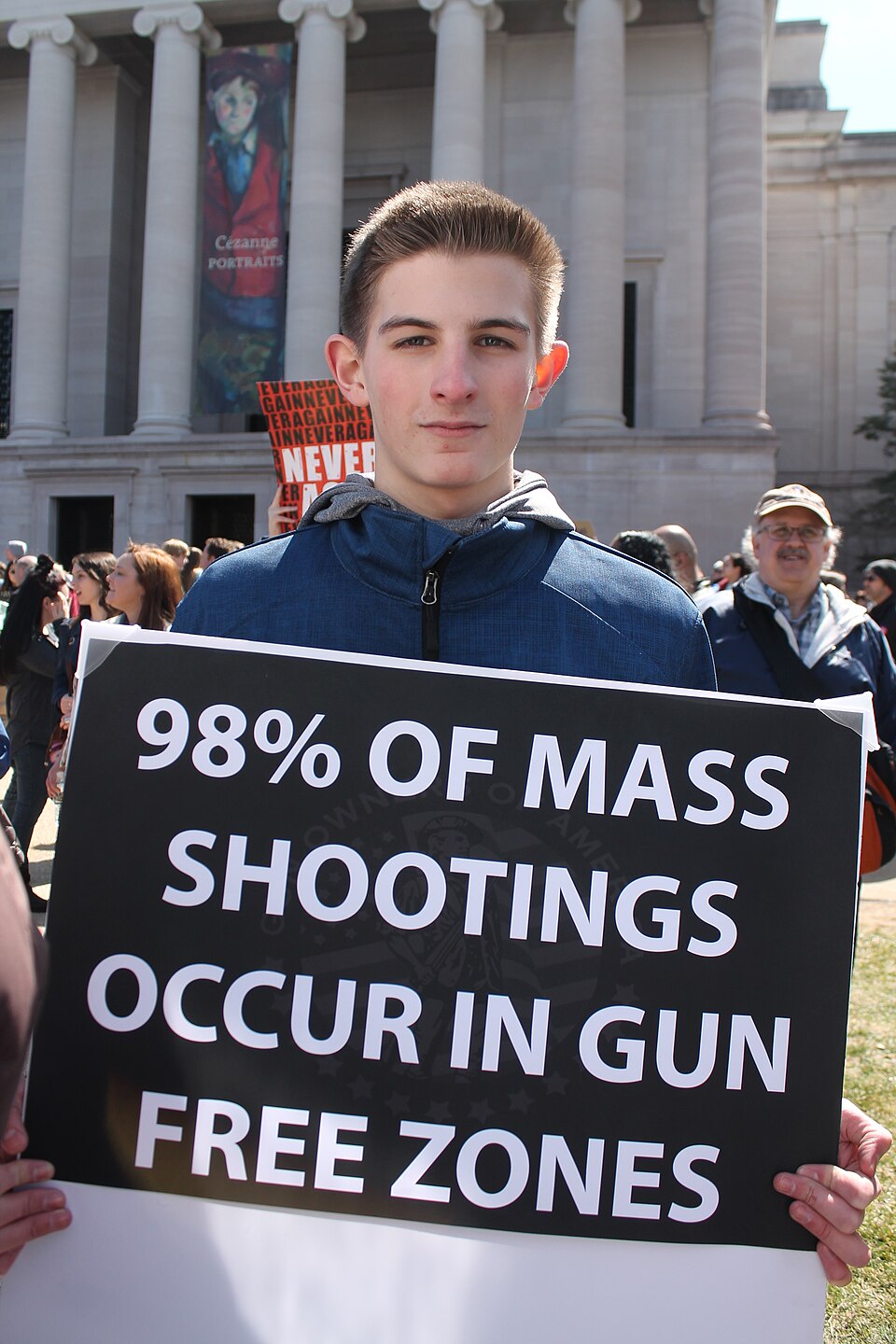
Gun rights supporters holding signs at the March for Our Lives in Washington, 2018
Elvert Barnes · CC BY-SA 2.0
Motion: This House would introduce much stricter gun control5 Pro · 5 Con · 26 sourcesEditor review: pending

Introduction

Gun control means the laws that decide who may own a gun, which guns they may own, and how guns are sold, stored and carried. The debate is about whether tighter rules, such as stronger background checks, bans on some weapons or limits on carrying guns in public, would save lives, or whether they would mostly burden law-abiding owners while criminals ignore them.

The United States is at the centre of the argument. American civilians own more than 393 million guns, about 120.5 for every 100 residents. That is roughly 46% of all civilian guns in the world, in a country with about 4% of the world's people.2 In 2023, 46,728 people in the US died from gun injuries. 58% of those deaths were suicides and 38% were murders, and about eight in ten American murders involved a gun.1

American law also protects gun ownership. In District of Columbia v. Heller (2008), the Supreme Court ruled 5 to 4 that the Second Amendment protects an individual's right to own a gun, and struck down Washington DC's handgun ban. It added: “Like most rights, the Second Amendment right is not unlimited.”3 In 2022, the Court ruled 6 to 3 that gun laws must be consistent with the nation's historical tradition of gun regulation.4

Elsewhere, mass shootings have often led to sweeping change. After a gunman killed 35 people at Port Arthur in 1996, Australia bought back and destroyed more than 650,000 semiautomatic and pump-action rifles and shotguns.6 Britain banned private ownership of handguns in 1997, after a gunman killed 16 children and their teacher at a school in Dunblane, Scotland.8 When 22 people were killed in Nova Scotia in 2020, Canada banned more than 1,500 models of assault-style firearms. “Canadians need more than thoughts and prayers,” Prime Minister Justin Trudeau said.18

The US has moved more slowly. In May 2022, 19 children and two teachers were killed at a school in Uvalde, Texas, and 10 people at a supermarket in Buffalo, New York. A month later Congress passed the Bipartisan Safer Communities Act, which added enhanced background checks and money for states that adopt “red flag” laws. It was described as the most significant federal gun law in nearly three decades.10 Yet in 2024 the Supreme Court struck down a federal ban on bump stocks, devices used in the 2017 Las Vegas shooting that killed 60 people.17

Americans remain divided. In a 2023 Gallup poll, 56% wanted stricter gun laws, 31% wanted them kept as they are and 12% wanted them less strict. Support for stricter laws was 88% among Democrats but only 26% among Republicans.11 About 72% of gun owners say protection is a major reason they own a gun.12

The main fault lines are about rights, evidence and who obeys the law. A RAND Corporation review found good evidence that some laws, such as rules on safe storage around children, reduce deaths, but too little evidence to judge others, such as assault weapons bans.5 Opponents add that 90% of prisoners who had a gun during their crime did not buy it from a store.13

Key terms

Second Amendment
The part of the US Constitution that protects the right to keep and bear arms. Courts decide how far that right goes.
Background check
A check of a buyer's records, for crimes or other legal bans, before they are allowed to buy a gun.
Universal background checks
Requiring a background check on almost every gun sale, including private sales between individuals, not only sales by licensed dealers.
Red flag law
A law that lets a court temporarily take guns from someone judged to be a danger to themselves or others.
Assault weapon
A loose term for semi-automatic rifles and other guns with military-style features. Each law defines it differently.
Buyback
A scheme in which the government pays owners to hand in guns, often after those guns have been banned.
Child access prevention law
A safe storage law that makes adults responsible for keeping guns locked away from children.
Defensive gun use
Using a gun to protect yourself or others from a crime, which usually means showing it rather than firing it.

Pros and cons at a glance

Pro: control guns more tightly

    Con: keep or loosen current laws

      Pro arguments

      Con arguments

      Key clashes

      Most gun control debates are won or lost on these four questions.

      1Rights or safety: which comes first?

      A question of values as much as evidence.

      Pro saysEven the Supreme Court says the right to bear arms is not unlimited. When tens of thousands die each year, public safety justifies firm limits.13
      Con saysSelf-defence is a basic right, protected by the Constitution. The government should not take it away from people who have done nothing wrong.323

      2Do gun laws actually work?

      Both sides can point to research, and much of it is mixed.

      Pro saysSafe storage laws, background checks and waiting periods have good evidence behind them, and Australia ended mass shootings after its reforms.57
      Con saysThe best-known US ban, on assault weapons, showed no clear effect, and Australia's gun deaths were already falling before 1996.257

      3Who do gun laws really affect?

      The answer depends on where criminals get their guns.

      Pro saysGuns often start out legal and are then passed on, stolen or trafficked. Tighter rules at the start make it harder for them to reach criminals.14
      Con saysMost criminals get guns on the street, not in shops, so new rules mostly fall on law-abiding buyers.13

      4Does a gun make a home safer or more dangerous?

      The same gun can protect a family or be used in a tragedy.

      Pro saysPeople with access to a gun are about three times more likely to die by suicide, and gun suicide attempts are usually fatal.1920
      Con saysGuns are used to stop crimes many times each year, and most owners keep one for exactly that reason.1512

      Around the world

      The US: Americans own about 46% of the world's civilian guns, and the Supreme Court protects an individual right to own one.23

      Australia, Britain, New Zealand and Canada: each tightened its laws sharply after a mass shooting, through buybacks or bans on handguns or semi-automatic weapons.68918

      Japan: private citizens may not own handguns, and buying a shotgun takes more than a dozen steps, including exams and a police interview. Just one person was killed by gun violence in Japan in 2021.26

      Switzerland: has about 2.3 million civilian guns, yet in 2019 more than 63% of voters approved tighter EU-style rules on semi-automatic rifles.24

      Mexico: 70% of guns recovered there from 2014 to 2018 and traced came from the United States.14

      Debate tip: comparing countries is useful evidence on both sides. Pro can point to low gun deaths where laws are strict; Con can argue that the US, with hundreds of millions of guns and a constitutional right, cannot simply copy another country.

      Discussion questions

      For class or club discussion. There are no right answers; ask for reasons and evidence.

      1. Should guns be more tightly controlled? Explain your answer using at least one argument from each side.
      2. Is owning a gun for self-defence a basic right, like free speech, or a privilege that the state can limit?
      3. More than half of US gun deaths are suicides. Should that change how we think about gun laws, which are often debated in terms of crime?
      4. If criminals mostly get guns illegally, can laws aimed at legal buyers still reduce gun violence? How?
      5. Australia and Japan have strict laws and few gun deaths. What would make their approach easier or harder to copy in the United States?

      Sources

      1. Pew Research Center, “What the data says about gun deaths in the U.S.,” updated March 5, 2025. LinkResearch nonprofit
      2. Small Arms Survey figures, as reported in “There are more guns than people in the US,” World Economic Forum (from The Washington Post), June 21, 2018. LinkResearch survey, via news report
      3. Supreme Court of the United States, District of Columbia v. Heller, 554 U.S. 570 (2008), syllabus. LinkCourt ruling
      4. Michael A. Foster, Congressional Research Service, “The Second Amendment at the Supreme Court: New York State Rifle & Pistol Ass'n v. Bruen,” June 29, 2022. LinkGovernment report
      5. Andrew R. Morral, RAND Corporation, “The Gun Laws That Work, and the Gun Laws That Don't,” May 27, 2022. LinkResearch organisation
      6. “Tough gun laws in Australia eliminate mass shootings,” Science News, June 2016, reporting S. Chapman, P. Alpers and M. Jones in JAMA. LinkPeer-reviewed study, via science news
      7. University of Sydney, “Australia 20 years after gun reform: no mass shootings, declining firearm deaths,” June 23, 2016. LinkUniversity research release
      8. “The UK's last school shooting was in 1996. It overhauled its gun control laws after, and there hasn't been another,” Business Insider, May 2022. LinkNews report
      9. “New Zealanders hand in more than 50,000 weapons as the country's buyback program ends,” NPR, December 21, 2019. LinkNews report
      10. Erin Doherty, “Congress sends bipartisan gun safety bill to Biden's desk,” Axios, June 24, 2022. LinkNews report
      11. Gallup, “Majority in U.S. Continues to Favor Stricter Gun Laws,” October 31, 2023. LinkPoll
      12. Pew Research Center, “Key facts about Americans and guns,” July 24, 2024. LinkResearch nonprofit
      13. Mariel Alper and Lauren G. Beatty, Bureau of Justice Statistics, “Source and Use of Firearms Involved in Crimes: Survey of Prison Inmates, 2016,” January 2019. LinkGovernment report
      14. US Government Accountability Office, “Firearms Trafficking: U.S. Efforts to Disrupt Gun Smuggling into Mexico Would Benefit from Additional Data and Analysis,” GAO-21-322, February 2021. LinkGovernment report
      15. National Research Council, Firearms and Violence: A Critical Review, National Academies Press, 2005, chapter 5. LinkNational research body
      16. William English, “2021 National Firearms Survey,” Georgetown University, working paper, July 2021. LinkAcademic survey
      17. Ariana Figueroa, “U.S. Supreme Court overturns ban on bump stocks used in Las Vegas mass shooting,” Wisconsin Examiner (States Newsroom), June 14, 2024. LinkNews report
      18. Rob Gillies, Associated Press, “Canada bans assault-style weapons after 22 killed in Nova Scotia mass shooting,” May 1, 2020, via ABC7. LinkNews report
      19. University of California, San Francisco, “Access to Guns Increases Risk of Suicide, Homicide,” January 21, 2014, on A. Anglemyer, T. Horvath and G. Rutherford in Annals of Internal Medicine. LinkPeer-reviewed study, via university
      20. “Preventing suicides by reducing access to guns,” Harvard Gazette, February 21, 2013. LinkUniversity research news
      21. Ariana Figueroa, “U.S. Supreme Court upholds law that prevents domestic abusers from owning guns,” Maryland Matters (States Newsroom), June 21, 2024. LinkNews report
      22. NPR Washington Desk, “Unanimous Supreme Court rules against Mexico in guns case,” June 5, 2025, via WUWF. LinkNews report
      23. National Rifle Association Institute for Legislative Action, “NRA Statement in Response to Biden's Address,” June 2, 2022. LinkAdvocacy group position
      24. “Swiss voters approve tighter gun laws,” Al Jazeera, May 19, 2019. LinkNews report
      25. Christopher S. Koper, Daniel J. Woods and Jeffrey A. Roth, “An Updated Assessment of the Federal Assault Weapons Ban: Impacts on Gun Markets and Gun Violence, 1994-2003,” report to the National Institute of Justice, June 2004. LinkGovernment-funded study
      26. Rachel Treisman, “Abe's assassination shocks Japan, where gun control is strict and shootings are rare,” NPR, July 8, 2022, via GPB. LinkNews report

      Arguments marked “Evidence needed” are waiting for a source before this guide goes live.

      You might also debate

      Practise this topic

      Suggest an argument or source

      Anyone can suggest improvements. An editor checks every suggestion and source before it's added, and you're credited by name.

      Mockup: suggestions aren't saved yet.