← All topics
Environment and AnimalsBeginner to AdvancedWSDCBPPublic Forum

Should governments tax meat?

Supporters say meat is too cheap because its price ignores the damage to the climate, our health and animals. Opponents say a tax would hurt poorer families and farmers without fixing the problem.

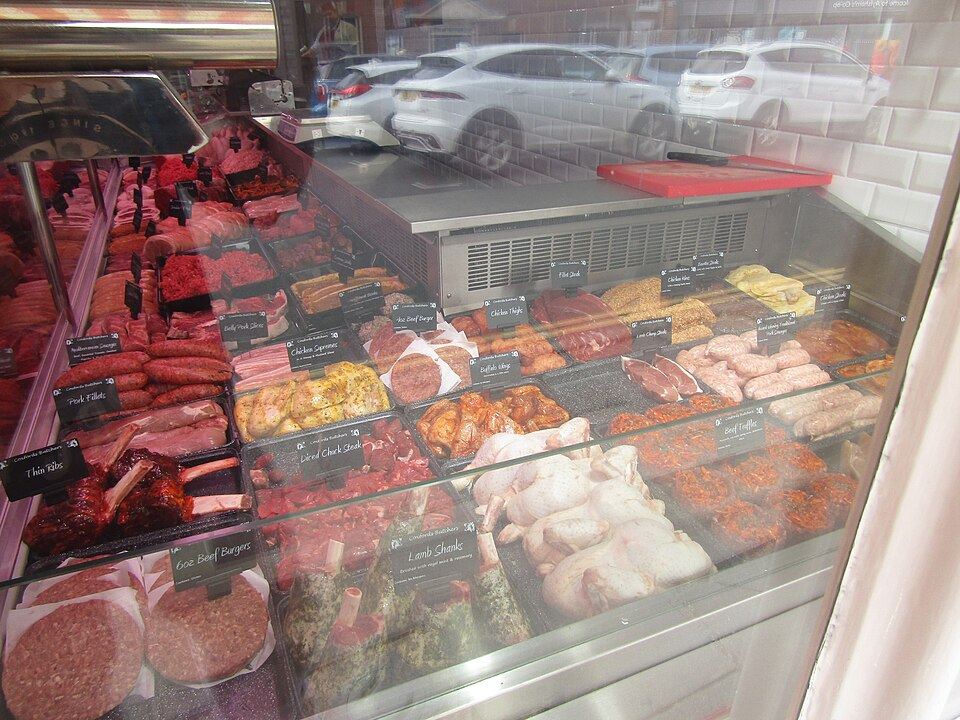
Cuts of meat on display at a butcher's counter
Kolforn · CC BY-SA 4.0
Motion: This House would tax meat5 Pro · 5 Con · 23 sourcesEditor review: pending

Introduction

A meat tax is a charge that makes beef, pork, chicken and other meat more expensive. It can be added at the checkout, like a sales tax, or charged to the farms that raise the animals. Supporters give three main reasons for it: to cut the greenhouse gases that livestock release, to improve people's health, and to raise money for better treatment of farm animals.

The idea is fairly new in politics. In 2013, Sweden's Board of Agriculture raised the possibility of a meat tax, and government ministers quickly ruled it out. Agriculture minister Eskil Erlandsson said: “People should decide for themselves what they want in their refrigerator.”1920

The case for a tax starts with numbers. The UN Food and Agriculture Organization (FAO) estimates that livestock produce about 6.2 billion tonnes of greenhouse gases a year, around 12% of all emissions caused by humans, and expects demand for animal products to grow by 20% by 2050.1 A 2016 Oxford study found that beef would need to cost about 40% more worldwide to pay for its climate damage.6 Health is part of the argument too. In 2015 the World Health Organization's cancer agency classified processed meat as “carcinogenic to humans” and found that each 50 gram portion eaten daily raises the risk of colorectal cancer by 18%.8

In 2024 Denmark became the first country to agree a tax on livestock emissions. From 2030, farmers will be charged 300 kroner per tonne of emissions, rising to 750 kroner by 2035, though a 60% deduction cuts the real rates to 120 and 300 kroner.2 That works out at roughly $96 per dairy cow a year at first.4 “We will be the first country in the world that introduces a CO2 tax on agriculture,” said Climate Minister Lars Aagaard.2

New Zealand went the other way. Nearly half of its greenhouse gas emissions come from about 10 million cows and 26 million sheep, and a plan announced in 2022 would have priced farm emissions from 2025. After nationwide farmer protests and a change of government, the plan was scrapped in June 2024.5

In the United States, the picture looks different. Livestock produced 4.3% of US greenhouse gas emissions in 2022, according to government data, and ground beef reached a record average of $6.12 a pound in June 2025.1421

The main fault lines are about who pays and whether it works. Poorer households spend more of their income on food, and the EU farm lobby Copa-Cogeca warns that a meat tax “would be terribly regressive in practice.”13 Supporters reply that the money can be handed back to families.12 Public opinion depends on the reason given: in a 2023 German survey of 2,800 people, 62% backed a small meat tax, rising to 68% when it was presented as helping animal welfare.22
Key terms

Externality
A cost (or benefit) of an activity that falls on people outside the deal, such as climate damage from producing food that the buyer does not pay for.
Pigouvian tax
A tax designed to make a product's price include the harm it causes to others, so people buy less of it. Named after the economist Arthur Pigou.
Regressive tax
A tax that takes a bigger share of income from poorer people than from richer ones. Taxes on food are often regressive.
CO2 equivalent (CO2e)
A common unit for comparing greenhouse gases. Methane from cattle is converted into the amount of carbon dioxide that would cause the same warming.
Enteric fermentation
Digestion in the stomachs of cattle, sheep and goats that produces methane, which the animals mostly burp out.
Carbon leakage
When a climate rule in one country pushes production, and its emissions, to countries with weaker rules instead of cutting them.
Revenue recycling
Giving the money raised by a tax back to people, for example as equal payments to every household or as cuts to other taxes.
Price elasticity of demand
How much people change what they buy when the price changes. It decides how much a tax actually cuts consumption.

Pros and cons at a glance

Pro: tax meat

    Con: don't tax it

      Pro arguments

      Con arguments

      Key clashes

      Most meat tax debates are won or lost on these four questions.

      1Is meat too cheap?

      A question about what a fair price should include.

      Pro saysToday's prices leave out the damage to the climate and to health, so the public pays the rest. Economists conclude that “meat is significantly underpriced.”9
      Con saysMeat is already expensive for many families, with US beef at record prices, and food is not a luxury to be taxed like tobacco.21

      2Who ends up paying?

      Both sides agree poorer households spend more of their income on food.

      Pro saysIf the money is handed back to every person as an equal payment, poorer families can come out ahead on average.12
      Con saysRebates are promised but not guaranteed, and the tax itself hits low-income shoppers hardest.13

      3Would emissions really fall?

      Climate change is global, but taxes are national.

      Pro saysHigher prices change what people buy, and one study estimated that about one billion tonnes of emissions could be avoided in a single year.6
      Con saysIf one country taxes its farmers, production moves to countries with weaker rules and the emissions simply move too.513

      4Tax or technology?

      Both sides want lower farm emissions; they disagree on the best tool.

      Pro saysA price rewards farmers who adopt cleaner methods. In Denmark, farmers using proven climate solutions can avoid much of the tax.3
      Con saysFeed additives and better farming can cut emissions while keeping food affordable, without punishing anyone.171

      Around the world

      Denmark: the first country to agree a tax on livestock emissions: 300 kroner per tonne from 2030, rising to 750 kroner in 2035, with the money going to a fund for greener farming.233

      New Zealand: planned to price emissions from cows and sheep, then scrapped the plan in 2024 after farmer protests.5

      Germany and the EU: Germany's Borchert Commission proposed an animal welfare levy on meat in 2020, and a Dutch campaign group urged the EU to add a sustainability charge to meat prices.1013

      The United States: livestock make up 4.3% of national emissions, a much smaller share than in New Zealand or Denmark, and the debate has focused more on beef prices than on taxes.14

      Debate tip: Pro can use Denmark to show a meat tax can be agreed with farmers; Con can use New Zealand to show how quickly such plans can collapse.

      Discussion questions

      For class or club discussion. There are no right answers; ask for reasons and evidence.

      1. Should governments tax meat? Explain your answer using at least one argument from each side.
      2. Is it fair to tax a food that many families rely on, if the money is given back to them? Why or why not?
      3. Should a meat tax be charged to shoppers at the checkout or to farmers on their emissions? Which is fairer, and which would work better?
      4. Which is the strongest reason for a meat tax: climate, health or animal welfare? Does the reason change whether you support it?
      5. If one country taxes meat and its neighbours do not, has it helped the planet or only hurt its own farmers?

      Sources

      1. Food and Agriculture Organization of the United Nations, “New FAO report maps pathways towards lower livestock emissions,” December 8, 2023. LinkInternational body
      2. “Denmark confirms plan for world first livestock CO2 tax by 2030,” The Local Denmark, November 18, 2024. LinkNews report
      3. Orla Dwyer and Yanine Quiroz, “Q&A: How Denmark plans to tax agriculture emissions to meet climate goals,” Carbon Brief, July 9, 2024. LinkClimate news analysis
      4. Seamus Webster, “World's first carbon tax on livestock will cost farmers $100 per cow,” Fortune, June 26, 2024. LinkNews report
      5. “New Zealand scraps ‘burp tax’ on livestock after backlash from farmers,” Al Jazeera, June 11, 2024. LinkNews report
      6. Oxford Martin School, University of Oxford, on Springmann et al., “Mitigation potential and global health impacts from emissions pricing of food commodities,” Nature Climate Change, November 7, 2016. LinkUniversity research
      7. Marco Springmann et al., “Health-motivated taxes on red and processed meat: A modelling study on optimal tax levels and associated health impacts,” PLOS ONE, November 6, 2018. LinkPeer-reviewed study
      8. Union for International Cancer Control, “IARC Monographs evaluate consumption of red meat and processed meat,” October 26, 2015. LinkInternational health body
      9. Franziska Funke et al., “Is Meat Too Cheap? Towards Optimal Meat Taxation,” INET Oxford Working Paper No. 2022-01, January 10, 2022. LinkAcademic research
      10. Sarah Kanning, interview with Jochen Borchert on redesigning livestock farming, deutschland.de, August 11, 2020. LinkInterview
      11. Food and Agriculture Organization of the United Nations, “Meat, eggs and milk essential source of nutrients especially for most vulnerable groups, new FAO report says,” April 25, 2023. LinkInternational body
      12. “New study reveals path to balanced meat taxes in the EU,” Fleischwirtschaft, October 20, 2023, on David Klenert and Franziska Funke, “Meat taxes in Europe can be designed to avoid overburdening low-income consumers,” Nature Food, 2023. LinkPeer-reviewed study, via trade press
      13. “EU lawmakers discuss sustainability charge on meat,” FeedNavigator, February 5, 2020. LinkTrade press
      14. Ryan Hanrahan, “U.S. Ag Emissions Lowest Since 2012,” Farm Policy News, University of Illinois, April 17, 2024 (EPA greenhouse gas inventory data). LinkGovernment data, via university
      15. City, University of London, “A major new report has developed a global diet that could improve health and reduce further damage to the planet” (EAT-Lancet Commission), January 17, 2019. LinkUniversity research
      16. “Dutch farmers' protest party scores big election win, shaking up Senate,” CNBC, March 16, 2023. LinkNews report
      17. “FDA approves Bovaer for use in US dairy cattle,” DairyReporter, May 28, 2024. LinkTrade press
      18. Max Roser, “How many animals get slaughtered every day?” Our World in Data, September 26, 2023. LinkResearch organisation
      19. “‘Slap carbon tax on meat to reduce emissions’,” The Local Sweden, January 22, 2013. LinkNews report
      20. “Borg says ‘No’ to meat tax,” Sveriges Radio, January 2013. LinkPublic broadcaster
      21. “The price of beef has hit record highs nationwide,” Axios, July 23, 2025 (Bureau of Labor Statistics data). LinkNews report
      22. Universität Hamburg, CLICCS, on Grischa Perino and Henrike Schwickert, “Animal welfare is a stronger determinant of public support for meat taxation than climate change mitigation in Germany,” Nature Food, February 23, 2023. LinkPeer-reviewed study, via university
      23. “Denmark's livestock emissions tax gets the nod in parliament,” Just Food, November 19, 2024. LinkTrade press

      Arguments marked “Evidence needed” are waiting for a source before this guide goes live.

      You might also debate

      Practise this topic

      Suggest an argument or source

      Anyone can suggest improvements. An editor checks every suggestion and source before it's added, and you're credited by name.

      Mockup: suggestions aren't saved yet.