← All topics
Science and TechnologyBeginner to AdvancedWSDCBPPublic Forum

Should children have smartphones?

Supporters say phones keep children safe, connected and ready for a digital world. Critics say they arrive too early, bringing risks children are not ready for.
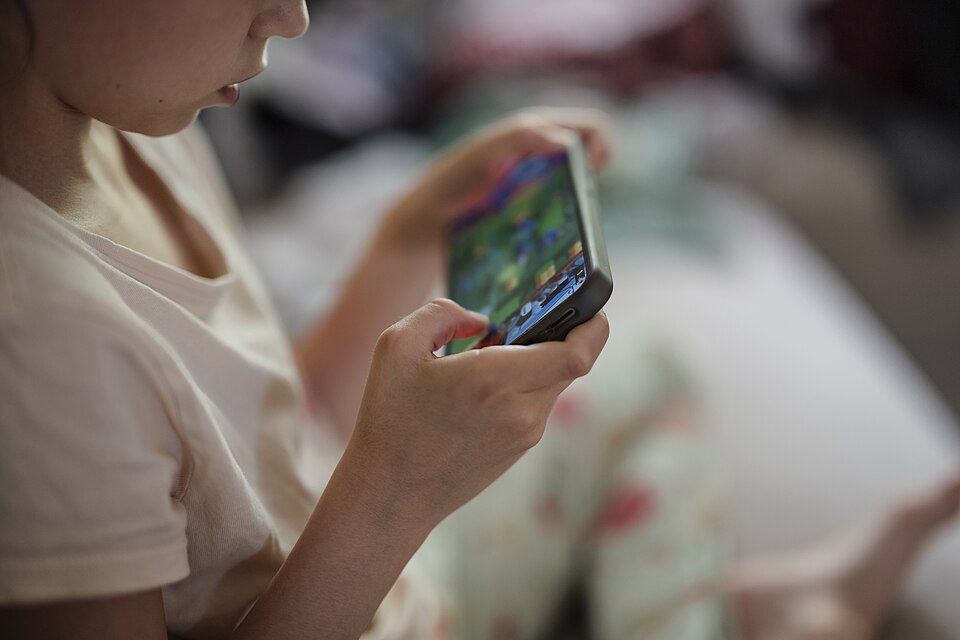
A child holding a smartphone and playing a game
Shixart1985 · CC BY 2.0
Motion: This House believes children should have smartphones5 Pro · 5 Con · 26 sourcesOctober 2026

Introduction

A smartphone is a pocket computer. It makes calls and sends texts, but it also opens the whole internet, app stores, cameras and social media. This debate is not about whether teenagers use smartphones, since almost all of them do. It is about whether children, roughly those under 13 or 14, should have one of their own.

Smartphones spread fast. In 2014–15, 73% of American teens had or could use one; by 2022 the figure was 95%, where it has stayed.1 Phones now reach younger children too. In a 2025 Pew survey, 23% of US parents of children aged 12 and under said their child had their own smartphone, rising to about 6 in 10 at ages 11 and 12.2 In the UK, ownership jumps from 56% of 10-year-olds to 83% of 11-year-olds, as children start secondary school.21

Parents mostly give phones to stay in touch: 81% of parents whose young child uses a smartphone call contact a major reason. Parents who say no mostly worry about what their child might see.2 Those fears are not imaginary. In a 2022 Common Sense Media survey, 73% of US teens aged 13 to 17 had seen online pornography, first at an average age of 12, and 58% had come across it by accident.20

In 2023, US Surgeon General Vivek Murthy warned: “We cannot conclude that social media is sufficiently safe for children and adolescents.”10 Psychologist Jonathan Haidt's 2024 book The Anxious Generation called for “No smartphones before high school.”23 Parents began acting together. In May 2023, the parents of all eight primary schools in Greystones, Ireland, backed a voluntary no-smartphone code. “Childhood seems to be getting shorter and shorter,” said one principal.8 In Britain, more than 180,000 people have signed the Smartphone Free Childhood Parent Pact.24

Researchers disagree sharply about the evidence. A study of more than 10,500 American children, published in Pediatrics in 2025, found that 12-year-olds with a smartphone had higher risks of depression, obesity and poor sleep than those without one.6 But a Stanford team that followed more than 250 children for five years found that the age of a first phone had no meaningful link to sleep, depression or grades.4 Reviewing Haidt's book in Nature, psychologist Candice Odgers wrote that “there is no evidence that using these platforms is rewiring children's brains or driving an epidemic of mental illness.”12

Governments are stepping in. In 2024, an expert panel set up by French President Emmanuel Macron recommended no phone at all before 11 and no internet-connected smartphone before 13.9 In December 2025, Australia began barring under-16s from having accounts on major social media platforms such as TikTok, Instagram and Snapchat.26

The debate turns on three questions. Do smartphones cause harm, or do they simply appear alongside problems with other causes? Is the danger the phone itself, or the apps on it? And who should decide when a child is ready: parents, communities or governments?

Key terms

Digital literacy
The skills to find, judge and create information online, and to use technology safely and responsibly.
Digital divide
The gap between people who have reliable devices and internet access and those who do not, often linked to family income.
Basic phone
A phone that can call and text but has no web browser or app store. Sometimes called a feature phone or “dumbphone.”
Sextortion
A crime in which someone gets sexual images of a person, then threatens to share them unless they are paid or sent more images.
Correlation and causation
Two things happening together (correlation) does not prove that one causes the other (causation). Many phone studies can only show correlation.
Displacement
The idea that time spent on a phone harms children mainly by crowding out other things, such as sleep, exercise and face-to-face play.
Precautionary principle
Acting to prevent possible harm before there is full scientific proof that the harm is real.
Collective action problem
A situation where everyone would be better off acting together, but no one wants to act alone, like being the only child in class without a phone.

Pros and cons at a glance

Pro: yes, children should have them

    Con: children should wait

      Pro arguments

      Con arguments

      Key clashes

      Most debates about children and smartphones are won or lost on these four questions.

      1Do smartphones actually harm children?

      Both sides cite large studies and read them differently.

      Pro saysScreen use explains only a tiny share of teenagers' wellbeing, and the age of a first phone shows no clear link to sleep, mood or grades.134
      Con saysThe largest recent US study found higher risks of depression, obesity and poor sleep among 12-year-olds with smartphones.6

      2Is the problem the phone or the apps?

      A smartphone can be limited, but only if the limits hold.

      Pro saysParents can decide which apps a child uses. The phone itself is a tool for school, maps and staying in touch with family.
      Con saysA basic phone covers calls and texts. Handing over a smartphone hands over the gateway to social media and the open internet.23

      3Does a phone make a child safer?

      Safety is the main reason parents buy phones, and the main reason others refuse.

      Pro saysMost parents give children phones so they can always reach each other, which makes more independence possible.2
      Con saysThe same device lets strangers reach children directly, as thousands of sextortion reports to the FBI show.18

      4Who should decide: families, communities or governments?

      A question about freedom and responsibility as much as about phones.

      Pro saysEvery child is different. Parents know their own children best, and blanket rules ignore that.4
      Con saysWhen families decide alone, social pressure wins. Shared pacts and public rules let everyone wait together.89

      Around the world

      The US: about 6 in 10 children aged 11 and 12 have their own smartphone, according to their parents, and 95% of teens have or can use one.21 There is no national rule; the choice is left to families.

      The UK: 83% of 11-year-olds own a smartphone.21 A parent-led campaign, Smartphone Free Childhood, says its Parent Pact has more than 180,000 signatures.24

      France: a 2024 expert panel appointed by President Macron recommended no phone before 11, no internet-connected smartphone before 13 and no social media apps before 15.9

      Ireland: in 2023, parents at all eight primary schools in Greystones agreed a voluntary no-smartphone code.8

      Australia: since December 2025, platforms such as TikTok, Instagram and Snapchat must keep under-16s off or face fines of up to A$49.5 million.26

      Debate tip: comparing countries is useful evidence on both sides. Con can point to a growing wave of limits; Pro can argue that most of these limits target social media, not the phone, and that rules work best when families choose them.

      Discussion questions

      For class or club discussion. There are no right answers; ask for reasons and evidence.

      1. Should children have smartphones? Explain your answer using at least one argument from each side.
      2. At what age, if any, is a child ready for a smartphone? What should readiness depend on besides age?
      3. If a basic phone can call and text, what does a smartphone add for a child, and is it worth the risks?
      4. Many studies show links between phones and health problems but cannot prove cause. How much proof should parents or governments need before acting?
      5. Should decisions about children's phones be made by each family, by schools and communities together, or by law?

      Sources

      1. Michelle Faverio and Olivia Sidoti, “Teens, Social Media and Technology 2024,” Pew Research Center, December 12, 2024. LinkResearch nonprofit
      2. Pew Research Center, “How parents describe their kids' tech use,” in How Parents Manage Screen Time for Kids, October 8, 2025. LinkResearch nonprofit
      3. Pew Research Center, “Screen time: US teens' and parents' experiences, approaches,” March 11, 2024. LinkResearch nonprofit
      4. Stanford Medicine news release on Sun et al., study of children's first mobile phones in Child Development, November 2022. LinkUniversity research
      5. “New study links early smartphone ownership to health risks,” Science News Explores, on Barzilay et al. in Pediatrics, 2025. LinkScience news
      6. “Kids who have smartphones by age 12 have higher risk of depression, obesity: Study,” ABC News via ABC7, December 2025. LinkNews report
      7. “Early smartphone use linked to poorer mental health in young adults,” News-Medical, on Thiagarajan et al. (Sapien Labs) in the Journal of Human Development and Capabilities, July 21, 2025. LinkPeer-reviewed study, via news
      8. Carl O'Brien, “Greystones parents agree to ‘no smartphone’ code for children until second level,” The Irish Times, May 26, 2023. LinkNews report
      9. Tassilo Hummel, “France must curb child, teen use of smartphones, social media, says panel,” Reuters, April 30, 2024. LinkNews report
      10. US Department of Health and Human Services, Office of the Surgeon General, “Surgeon General's Advisory on Social Media and Youth Mental Health,” 2023. LinkGovernment report
      11. Office of the Surgeon General, Social Media and Youth Mental Health, full advisory, May 2023. LinkGovernment report
      12. Candice L. Odgers, “The great rewiring: is social media really behind an epidemic of teenage mental illness?” Nature, March 29, 2024. LinkScientific journal review
      13. University of Oxford, “Technology use explains at most 0.4% of adolescent wellbeing, new study finds,” on Orben and Przybylski in Nature Human Behaviour, January 14, 2019. LinkUniversity research
      14. Emily A. Vogels, “Teens and Cyberbullying 2022,” Pew Research Center, December 15, 2022. LinkResearch nonprofit
      15. Pew Research Center, “Connection, Creativity and Drama: Teen Life on Social Media in 2022,” November 16, 2022. LinkResearch nonprofit
      16. Pew Research Center, “17% of teens sometimes can't finish homework because of digital divide,” October 26, 2018. LinkResearch nonprofit
      17. UN Committee on the Rights of the Child, General comment No. 25 (2021) on children's rights in relation to the digital environment, CRC/C/GC/25, March 2, 2021. LinkUN guidance
      18. FBI Sacramento Field Office, “Sextortion: A Growing Threat Preying Upon Our Nation's Teens,” January 17, 2024. LinkGovernment statement
      19. US Department of Justice, Office of Public Affairs, press release on the sentencing of two Nigerian brothers in the Jordan DeMay sextortion case, September 5, 2024. LinkGovernment statement
      20. Common Sense Media, “New Report Reveals Truths About How Teens Engage with Pornography,” January 10, 2023. LinkResearch nonprofit
      21. Ofcom, latest research on UK children's media lives: younger phone owners, the rise of AI and consumption over creation, May 21, 2026. LinkGovernment regulator
      22. Lauraine Langreo, Education Week report on digital distraction in OECD PISA 2022 results, December 8, 2023. LinkNews report
      23. Jonathan Haidt, The Anxious Generation movement, “The Four Norms.” LinkAuthor's campaign
      24. Smartphone Free Childhood, “Our impact.” LinkAdvocacy group
      25. University of Birmingham, “School bans alone not enough to tackle negative impacts of phone and social media use,” on Goodyear et al. in The Lancet Regional Health – Europe, February 2025. LinkUniversity research
      26. Agence France-Presse, “Australia bans under-16s from social media in world-first crackdown,” The Philippine Star, December 11, 2025. LinkNews report

      Arguments marked “Evidence needed” are waiting for a source before this guide goes live.

      You might also debate

      Practise this topic

      Suggest an argument or source

      Anyone can suggest improvements. An editor checks every suggestion and source before it's added, and you're credited by name.

      Mockup: suggestions aren't saved yet.