← All topics
EducationBeginner to AdvancedWSDCBPPublic Forum

Should cell phones be banned in schools?

Supporters say phones steal attention from learning and friendship. Opponents say bans miss the real problem and leave families unable to reach their children.
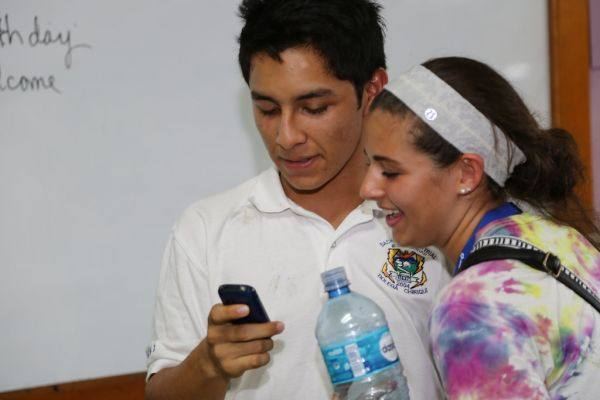
Two students looking at a mobile phone together in a classroom
AFS-USA Intercultural Programs · CC BY 2.0
Motion: This House would ban smartphones in schools5 Pro · 5 Con · 24 sourcesEditor review: pending

Introduction

A school phone ban stops students from using their mobile phones during the school day. Some bans cover only lessons. Stricter “bell-to-bell” bans cover the whole day, including lunch and breaks, and often require phones to be locked in pouches or lockers. The question matters because phones are part of almost every teenager's life: up to 95% of Americans aged 13 to 17 use social media.23 A 2023 Common Sense Media study found that more than half of the teens it tracked received 237 or more notifications a day, about a quarter of them during school hours.6

France was an early mover, banning phones in primary and lower secondary schools by a law of August 2018.13 In 2023, a UNESCO report found that fewer than one in four countries had banned smartphones in schools.2 By the end of 2024, 79 education systems, or 40% of those UNESCO tracks, had bans.1

The United States has moved quickly too. In 2023, Florida became the first state to require a ban, barring phone use during class time.8 By the 2025-26 school year, ABC News counted 20 states and territories, including Washington, D.C., that banned phones for the whole school day.16 When New York agreed its own bell-to-bell ban in 2025, Governor Kathy Hochul said: “We've protected our kids before from cigarettes, alcohol, and drunk driving,” adding, “and now we're protecting them from addictive technology designed to hijack their attention.”15

Teachers and the public mostly back limits. In a fall 2023 survey, 72% of US high school teachers called phone distraction a major problem in their classrooms.3 In 2024, 68% of American adults supported banning phones during class, but only 36% backed a ban for the whole school day.4

Early reports from abroad have encouraged supporters. After the Netherlands' ban began in January 2024, three-quarters of 317 surveyed high schools said students concentrated better, and a third saw better results.10 In New South Wales, Australia, 87% of nearly 1,000 principals said students were less distracted a year into their ban.11

Yet the hardest evidence is mixed. A 2025 study of 1,227 students at 30 schools in England found no difference in wellbeing, sleep or grades between schools that banned phones all day and schools that allowed them at breaks.17 In one large Florida district, test scores rose by the second year of a ban, but suspensions jumped by 25% in the first year, and Black students saw the biggest rise in discipline.8

Families are divided over safety. When a student shot two administrators at Denver's East High School in 2023, students in lockdown could only reach their parents by text. One mother, Jenn Silverstein, said: “The phone creates a sense of connection.”19 In a 2024 poll, 78% of parents whose children take phones to school said the reason was so they could use them in emergencies.19

Key terms

Bell-to-bell ban
A rule that bans phone use for the whole school day, from the first bell to the last, including lunch and breaks.
Class-time ban
A rule that bans phones only during lessons, so students can still use them at break or lunch.
Phone pouch
A lockable fabric pouch that a student carries but cannot open until staff unlock it at the end of the day.
Attention economy
The business model of apps and websites that earn money by capturing as much of a user's time and attention as possible.
Digital distraction
Losing focus on a task because of a phone, laptop or other device, your own or someone else's.
Exemption
Permission for a particular student to keep using a phone, for example because of a medical condition or disability.
Screen time
The total time a person spends looking at screens, both in and out of school.
Digital literacy
The skills to use technology safely, wisely and critically, including managing your own use.

Pros and cons at a glance

Pro: ban them

    Con: don't ban them

      Pro arguments

      Con arguments

      Key clashes

      Most phone ban debates are won or lost on these four questions.

      1Do bans actually improve learning?

      Both sides can point to serious studies with different results.

      Pro saysStudies in England and Florida found test scores rose after phones were banned, with the biggest gains for students who were struggling.78
      Con saysThe largest study of wellbeing and grades found no difference between schools that banned phones and schools that did not.17

      2Are phones a safety tool or a safety risk?

      Parents and safety experts often see emergencies very differently.

      Pro saysStudents on phones may miss safety instructions, and parents rushing to a school can get in the way of emergency responders.19 Kansas's education commissioner said he found “no evidence” that phones help in emergencies.16
      Con saysIn a real lockdown, a text may be the only way a frightened child can reach a parent, and most parents who send phones to school say this is why.19

      3Ban phones, or teach students to manage them?

      A question about what school is for.

      Pro saysTeenagers should not have to fight apps built to grab their attention all day. A clear rule protects them while they learn.15
      Con saysStudents will live with phones for the rest of their lives, so school should be where they practise using them well.1419

      4Is school the right place to tackle screen time?

      Even the critics of bans agree that heavy phone use can cause harm.

      Pro saysSchool is where adults can actually set the rules, and bans there have cut bullying and helped girls' mental health.9
      Con saysMost phone use happens outside school, so bans barely change total screen time. The fix has to include home.1718

      Around the world

      The global trend: by the end of 2024, 79 education systems, 40% of those tracked by UNESCO, had banned smartphones in school, up from 60 a year earlier. In China, the city of Zhengzhou now asks parents for written consent showing a phone is needed for teaching.1

      Europe: France banned phones in primary and lower secondary schools in 2018, and from the 2025-26 school year its lower secondary schools must keep phones stored away, after more than 32,000 students tested the idea.13 The Netherlands began its ban in January 2024,10 and England's 2024 guidance backs headteachers who ban phones for the whole day.12

      Latin America and Australia: Brazil's national law of January 2025 bans phones in class and at break time, but allows them for learning, emergencies and health needs.14 In Australia, New South Wales and South Australia have bans.1

      The US: rules vary by state. By the 2025-26 school year, 20 states and territories banned phones for the whole school day, while others left decisions to districts.16

      Debate tip: comparing countries is useful evidence on both sides. Pro can point to how fast bans are spreading and what schools report; Con can point out that school surveys are not the same as careful studies, and that the strongest research so far is mixed.

      Discussion questions

      For class or club discussion. There are no right answers; ask for reasons and evidence.

      1. Should cell phones be banned in schools? Explain your answer using at least one argument from each side.
      2. Is a ban during lessons enough, or should phones be locked away for the whole day, including lunch and breaks?
      3. If a ban raised test scores but also led to more suspensions, would it still be worth it? Who should decide?
      4. How should schools balance students' focus with families' wish to reach them in an emergency?
      5. Whose job is it to manage teenagers' screen time: students, parents, schools, governments or tech companies?

      Sources

      1. UNESCO Global Education Monitoring Report team, “To ban or not to ban? Monitoring countries' regulations on smartphone use in school,” World Education Blog, January 23, 2025 (updated September 2025). LinkInternational body
      2. Giulia Carbonaro, “UNESCO calls for schools around the world to ban smartphones in the classroom,” Euronews, July 26, 2023. LinkNews report
      3. Jenn Hatfield, “72% of U.S. high school teachers say cellphone distraction is a major problem in the classroom,” Pew Research Center, June 12, 2024. LinkResearch nonprofit
      4. Pew Research Center, “Most Americans back cellphone bans during class, but fewer support all-day restrictions,” October 14, 2024. LinkPoll
      5. Lauraine Langreo, “Digital distractions in class linked to lower academic performance,” Education Week, December 8, 2023, reporting OECD PISA 2022 results. LinkNews report
      6. Common Sense Media, “Teens Are Bombarded with Hundreds of Notifications a Day on Their Smartphones, New Report Reveals,” September 26, 2023. LinkResearch nonprofit
      7. Louis-Philippe Beland and Richard Murphy, “Ill Communication: Technology, Distraction & Student Performance,” Centre for Economic Performance, London School of Economics, Discussion Paper 1350, 2015. LinkAcademic study
      8. David N. Figlio and Umut Özek, “Can Banning Cellphones Save Student Learning? Evidence from Florida, home of the first statewide mandate,” Education Next, 2026. LinkAcademic study
      9. Shannon Larson, “Norway banned smartphones in school. Here's what happened after,” The Boston Globe, April 27, 2024, reporting a study by Sara Abrahamsson, Norwegian School of Economics. LinkNews report
      10. Reuters, “Study finds smartphone bans in Dutch schools improved focus,” published by Malay Mail, July 6, 2025. LinkNews report
      11. NSW Government, “Mobile phone ban improves learning, concentration and socialisation,” media release, October 21, 2024. LinkGovernment statement
      12. UK Department for Education, “Government launches crackdown on mobile phones in schools,” press release, February 19, 2024. LinkGovernment statement
      13. French Ministry of National Education, “Interdiction du téléphone portable dans les écoles et les collèges et pause numérique” (in French). LinkGovernment policy
      14. AFP, “Playgrounds come alive again with Brazil school phone ban,” published by Eyewitness News, February 11, 2025. LinkNews report
      15. News 12 Hudson Valley, “Lawmakers approve bell-to-bell cellphone ban in schools starting in the fall,” April 29, 2025. LinkNews report
      16. ABC News, “Here are the states banning cellphones in schools and what it means for students,” published by WTOP, September 2025. LinkNews report
      17. University of Birmingham, “School bans alone not enough to tackle negative impacts of phone and social media use,” February 5, 2025, on the Smart Schools study in The Lancet Regional Health Europe. LinkPeer-reviewed study
      18. Helen A. Weiss and Chris Bonell, “Smartphone use and mental health: going beyond school restriction policies,” The Lancet Regional Health Europe, vol. 51, February 2025. LinkJournal commentary
      19. Wellington Soares, “Why do parents oppose cell phone bans? They want to reach their kids if ‘the worst happens,’” Chalkbeat, September 13, 2024. LinkNews report
      20. American Diabetes Association Safe at School Working Group, “Information on Students with Diabetes Access to Smart Devices,” August 21, 2024. LinkMedical association
      21. Vicky Nguyen, Abigail Brooks, Jackie Balestrieri and Phoebe Wiener, “Schools spend millions on pouches to keep phones out of students' hands,” NBC News, September 12, 2025. LinkInvestigative journalism
      22. Amanda Third, “No, Education Minister, we don't have enough evidence to support banning mobile phones in schools,” Western Sydney University, December 10, 2020. LinkOpinion, researchers
      23. US Department of Health and Human Services, Office of the Surgeon General, “Social Media and Youth Mental Health: The U.S. Surgeon General's Advisory,” 2023. LinkGovernment report
      24. Phil Galewitz, “Schools Aren't as Plugged In as They Should Be to Kids' Diabetes Tech, Parents Say,” KFF Health News, January 28, 2025. LinkNews report

      Arguments marked “Evidence needed” are waiting for a source before this guide goes live.

      You might also debate

      Practise this topic

      Suggest an argument or source

      Anyone can suggest improvements. An editor checks every suggestion and source before it's added, and you're credited by name.

      Mockup: suggestions aren't saved yet.