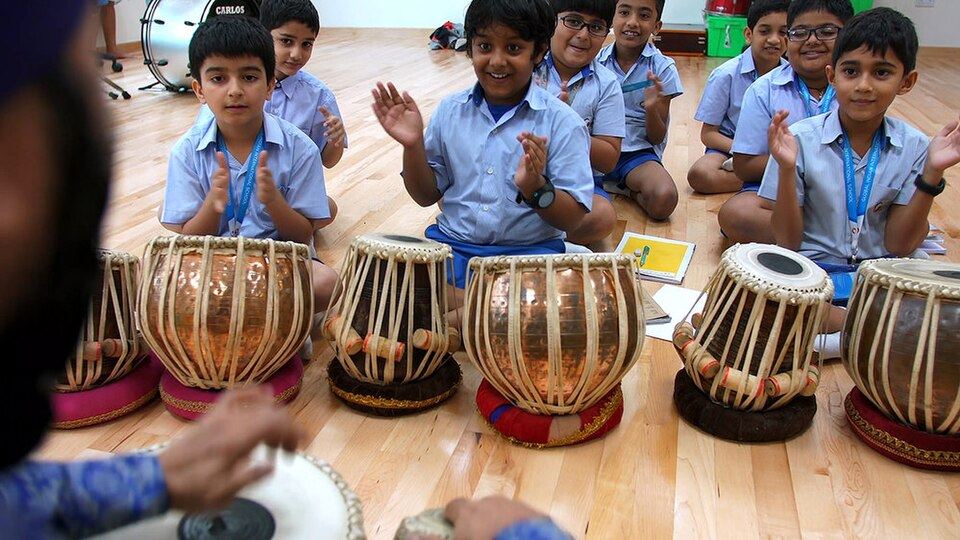
Should every student have to take art and music, or should they be optional extras? Most countries teach the arts to young children, but they disagree about how much time these subjects deserve, how long they should stay compulsory, and whether the money would do more good elsewhere.
In the United States, the argument sharpened when school ratings came to depend on reading and math tests. In a 2008 survey, 58% of school districts said they had added time for reading, and 16% said they had cut time for art and music.12 The 2015 Every Student Succeeds Act tried to widen the focus again, naming music and the arts as part of a “well-rounded education.”11
Almost every American elementary school offers some music: 94% did in 2009-10, and 83% offered visual arts. But access is uneven. Music was taught in 89% of the poorest elementary schools, compared with 97% of the least poor.9 States set their own rules, and nine states have no arts requirement for high school graduation.10
England makes art and design and music compulsory from age 5 to 14 in state-maintained schools.3 After that the arts are optional, and the share of students taking at least one arts GCSE fell from 57.1% in 2014 to 53.5% in 2016. School leaders blamed tight budgets and a performance measure called the EBacc, which rewards other subjects.4 In 2025 a government review found the EBacc had “limited their access to, and the time available for, arts and vocational subjects,” and ministers announced they would scrap it.56 Even where music is required, the chief inspector of schools warned in 2023 that “music is not given enough time in secondary schools.”7
The research is mixed. In Houston, a lottery decided which schools received extra arts programs. In the winning schools, the share of students disciplined fell by 3.6 percentage points and writing scores rose.1 Yet a 2020 review of 54 studies involving nearly 7,000 children concluded that “researchers’ optimism about the benefits of music training is empirically unjustified.”14
Some researchers say that misses the point. Samuel Mehr, whose 2013 Harvard experiments found that music classes did not make four-year-olds better at thinking tests, still argued: “Music says something about what it means to be human, and it would be crazy not to teach this to our children.”13
Opponents reply that time and money are limited. When California voters approved Proposition 28 in 2022, setting aside about $1 billion a year for school arts, critics called it “ballot box budgeting.”18 By 2026, dozens of districts had returned arts money, unsure how to follow the rules, and one study counted a shortfall of 5,000 arts teachers in the state.20 The debate turns on what the arts are for, whether they deserve a guaranteed place in a crowded timetable, and who should decide.