The homework machine: what schools are learning about AI
Chatbots arrived in classrooms almost overnight. Teachers, students and researchers are still working out what they mean for learning.
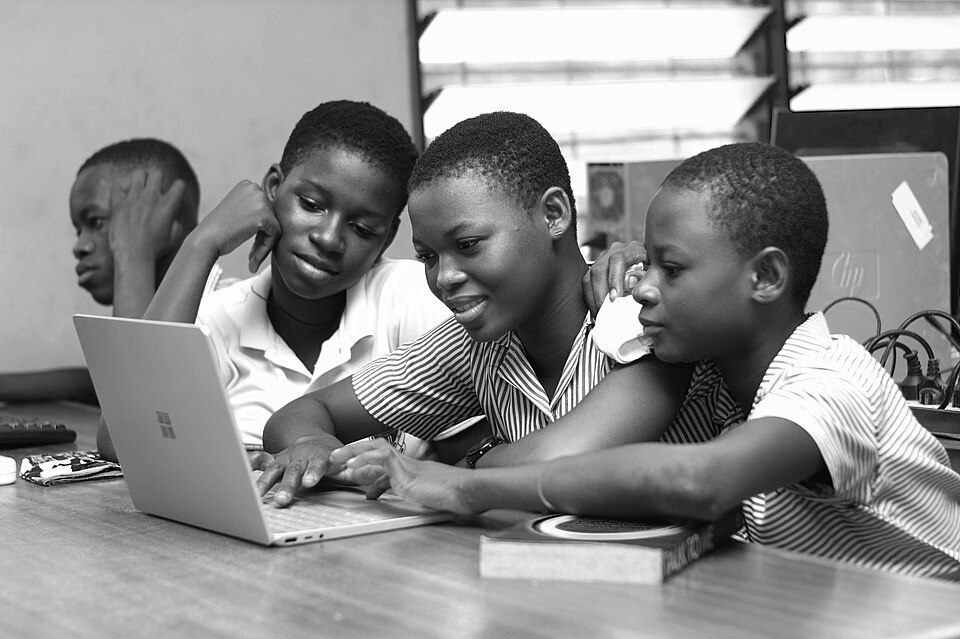
In an AP literature class at John Jay High School in Lewisboro, New York, there were no laptops out. Students marked up paper copies of a poem, then picked up their notebooks. "I want you to write out a really rough, terrible draft in your writers' notebooks," their teacher, Jessica Binney, told them. "And then I want you to scratch it out and rewrite it."1
Binney had stopped assigning take-home papers. Her students now write essays in class, by hand or on a locked-down laptop. Her classroom shows how much has changed since chatbots such as ChatGPT arrived, and how unsure schools still are about what comes next.
Ban first, rethink later
Soon after ChatGPT was released in November 2022, New York City Public Schools put it on its list of restricted websites on school devices and networks.23 By May 2023, the city had changed course. Chancellor David Banks wrote that "the knee-jerk fear and risk overlooked the potential of generative AI to support students and teachers."2 Manhattan Borough President Mark Levine called the reversal "absolutely the right move."3
In Pew Research Center surveys, the share of US teens who said they had used ChatGPT for schoolwork doubled from 13% in 2023 to 26% in 2024.4 In a 2026 Pew report, just over half of teens said they had used chatbots for schoolwork help, and one in ten said they did all or most of their schoolwork with a chatbot's help.5 RAND, a research group, found that the share of students using AI for homework rose from 48% to 62% between May and December 2025.6
The cheating question
Many teachers were worried from the start. In a 2023 Pew survey of public school teachers, 25% said AI tools do more harm than good in K-12 education, and only 6% said they do more good than harm.7 Students see the problem too: 59% of teens told Pew that using AI to cheat is a regular occurrence at their school.5
Stanford researchers tested seven AI detectors on 91 essays written by people for the TOEFL English exam. On average, the detectors wrongly labeled 61% of them as AI-generated.8 In a RAND survey, half of students said they worry about being falsely accused of using AI to cheat.9 Binney, for her part, was relieved to stop relying on detection tools she found unreliable.1
Some teachers see a deeper loss than cheating. "They are using generative AI to write before they learn how to write," said Breton Sheridan, an English teacher in Philadelphia. Marc Watkins, who directs the AI Institute for Teachers at the University of Mississippi, said of the take-home research essay: "That is, unfortunately, gone."1
What the research shows so far
Experiments so far point in different directions. In a study of nearly a thousand high school math students in Turkey, those given a plain version of GPT-4 for practice did 48% better on practice problems. But when the tool was taken away, they did 17% worse on exams than students who never had it. A second version, set up by teachers to give hints instead of answers, largely avoided that drop.1011 Alp Sungu, one of the researchers, said that "students tend to use standard generative AI tools as an answer machine."11
At Harvard, a different experiment in an introductory physics course found that students who learned from a carefully designed AI tutor learned more than students in an in-class active learning lesson, and in less time. The authors wrote that "students learn significantly more in less time when using the AI tutor."12
Who writes the rules?
Rules have lagged behind use. When UNESCO surveyed more than 450 schools and universities in 2023, fewer than 10% had formal guidance on generative AI.13 In 2025, only 45% of US principals reported having school or district AI policies or guidance.9 "These findings suggest schools need to be explicit about when and how AI can be used," said Heather Schwartz of RAND.6
Students are torn. In RAND's December survey, 67% said using AI for schoolwork harms critical thinking.6 Naomi Siegel, a senior in Binney's class, put both sides in one breath. "It's really concerning how dependent we are," she said. "But," she added, "we're getting into a world full of technology, and we have to learn how to allow it to benefit us."1
The debate is far from settled. If a tool helps you finish homework but leaves you worse at the test, has it helped you learn? Should schools build AI into lessons, or protect some work from it entirely? And who should decide where the line falls: teachers, schools, governments or students themselves?
For the strongest arguments on both sides, see the pro and con guide below.
Should students be allowed to use AI for schoolwork?
- The New York Times, "How A.I. Killed Student Writing (and Revived It)," republished by The Boston Globe, May 2, 2026. Link
- David C. Banks, "ChatGPT caught NYC schools off guard. Now, we're determined to embrace its potential," Chalkbeat, May 18, 2023. Link
- NBC News, "New York City public schools remove ChatGPT ban," NBC News, May 2023. Link
- Olivia Sidoti, Eugenie Park and Jeffrey Gottfried, "About a quarter of U.S. teens have used ChatGPT for schoolwork, double the share in 2023," Pew Research Center, January 15, 2025. Link
- Colleen McClain, Monica Anderson, Olivia Sidoti and William Bishop, "How Teens Use and View AI," Pew Research Center, February 24, 2026. Link
- RAND, "Student Use of AI for Homework Rises as Concerns Grow About Critical Thinking Skills," RAND Corporation, March 17, 2026. Link
- Luona Lin, "A quarter of U.S. teachers say AI tools do more harm than good in K-12 education," Pew Research Center, May 15, 2024. Link
- Weixin Liang, Mert Yuksekgonul, Yining Mao, Eric Wu and James Zou, "GPT detectors are biased against non-native English writers," arXiv (published in Patterns), July 10, 2023. Link
- Christopher Joseph Doss et al., "AI Use in Schools Is Quickly Increasing but Guidance Lags Behind: Findings from the RAND Survey Panels," RAND Corporation, September 30, 2025. Link
- Hamsa Bastani et al., "Generative AI without guardrails can harm learning: Evidence from high school mathematics," Proceedings of the National Academy of Sciences, 2025. Link
- PsyPost, "Unrestricted generative AI harms high school math learning by acting as a crutch," PsyPost, 2025. Link
- Greg Kestin, Kelly Miller, Anna Klales, Timothy Milbourne and Gregorio Ponti, "AI tutoring outperforms in-class active learning: an RCT introducing a novel research-based design in an authentic educational setting," Scientific Reports, June 3, 2025. Link
- UNESCO, "UNESCO: Governments must quickly regulate Generative AI in schools," UNESCO, September 7, 2023. Link